
India · lunch · dinner · celebration-food
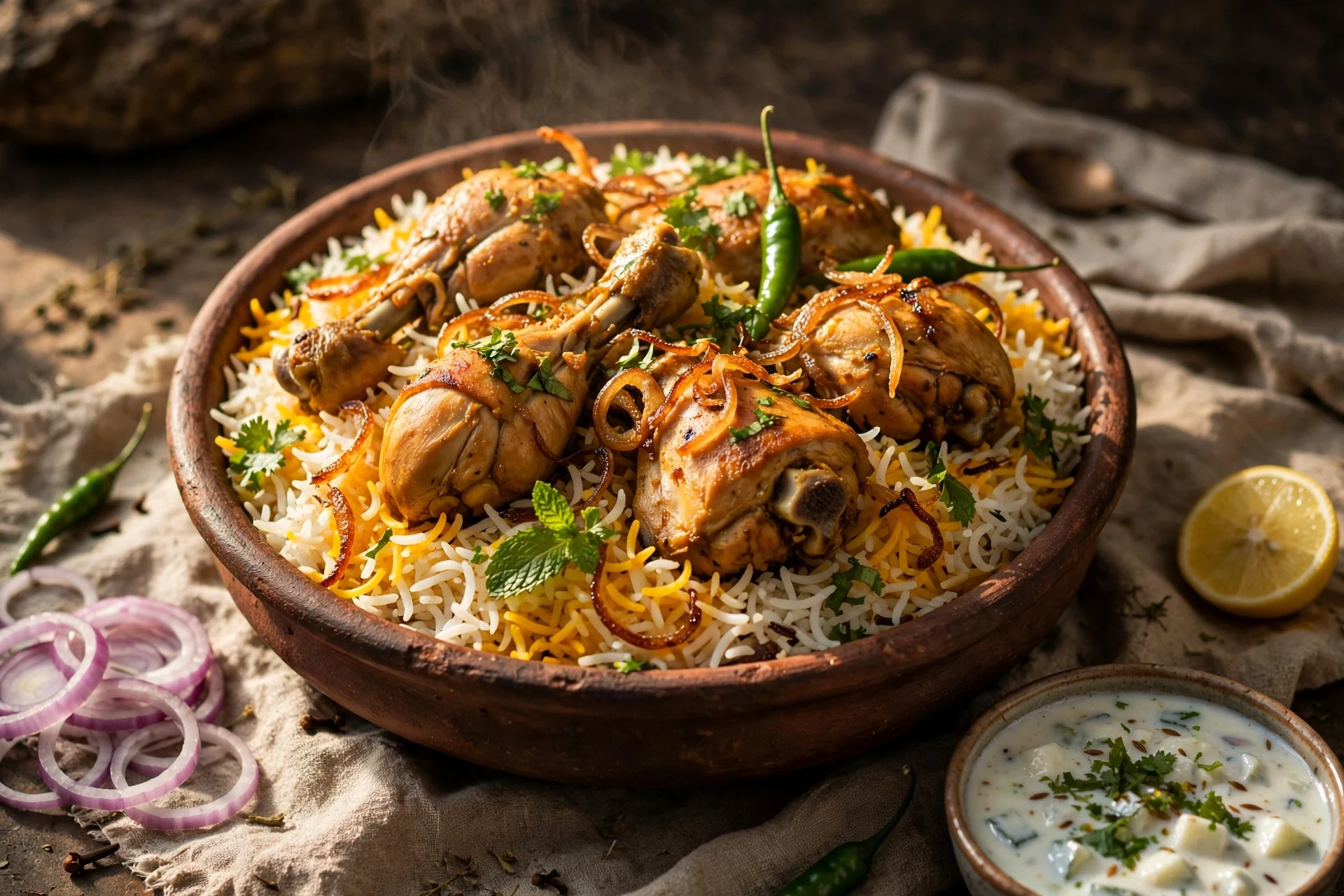
Hyderabadi Chicken Biryani
Grain, technique and memory on one plate.
Hyderabadi chicken biryani layers raw yogurt-spiced chicken with partially cooked basmati, birista, herbs, saffron and ghee before finishing under dum. This Ember & Equator version follows a kachhi-style home workflow: the rice must stay separate, the chicken must cook safely through, and the sealed pot should build aroma without scorching.
- Total
- 120 min
- Difficulty
- Hard
- Serves
- 6
- Steps
- 12
The dish
The grain tells part of the story.
Hyderabadi biryani is central to Hyderabad’s food culture and exists in both kachhi and pakki traditions. In kachhi biryani, marinated raw meat cooks under par-cooked rice in a sealed vessel; pakki versions cook the meat separately before layering. Ember & Equator uses a kachhi-style chicken method and treats household spice and perfume choices as variations rather than a single fixed formula.
Explore IndiaAt a glance
Origin
India
Region
Hyderabad, Telangana, Deccan Plateau
Meal
lunch · dinner · celebration-food
Guided steps
12
Dish
Hyderabadi Chicken Biryani
Cuisine
Indian cuisine
Food type
Lunch · Dinner · Rice dish
Technique
Marinate · Parboil · Layer
Cook the recipe
In the kitchen
Start with the ingredients, then follow the Method in order. Open cooking tips only when you need extra help; the story and references can wait until you are ready.
- Total
- 120 min
- Serves
- 6
- Level
- Hard
- Visual cues
- 12
Ingredients
Serves 6- 500 gramsbasmati riceaged long-grain preferred
- 1 kgbone-in chickenskin removed, medium pieces; thighs and drumsticks are especially forgiving
- 250 gramsplain yogurtwhole-milk, unsweetened
- 3 largeyellow onionsvery thinly sliced for birista; yields about 2 cups fried onions
- 500 mlneutral oilfor frying birista; reserve 3 tbsp of the cooled onion oil for the marinade and strain/store the rest for another use
- 3 tbspginger-garlic paste
- 4 wholegreen chilliesslit lengthwise
- 1 cupfresh mintloosely packed, roughly torn, divided
- 1 cupcilantroloosely packed, roughly chopped, divided
- 2 tbsplemon juice
- 1/2 tspground turmeric
- 1 tspKashmiri chilli powderincrease slightly for more heat if desired
- 1 tspgaram masalaor a restrained Hyderabadi-style biryani masala
- 1 tspshahi jeeracaraway-like black cumin; divide between marinade and rice water
- 6 podswhole green cardamomfor the rice water
- 1 piececinnamon stickabout 5 cm / 2 in, for the rice water
- 6 wholeclovesfor the rice water
- 1 generous pinchsaffron threadssoaked in 3 tbsp warm milk for at least 10 minutes
- 3 tbspmilkwarmed for the saffron
- 4 tbspgheemelted, divided
- 2 tbspfine saltdivided, plus more for the rice water as needed
Optional
- 1 pinchmace powderoptional but characteristic; use sparingly
- 1 tspkewra wateroptional; use sparingly so the biryani does not taste perfumed
Everything ready? Continue straight into the cooking steps.
Start methodMethod
12 stepsMethod at a glance
 Step 01
Marinate the chicken deeply and keep it cold
120 min
Pat the chicken dry and place it in a large non-reactive bowl.
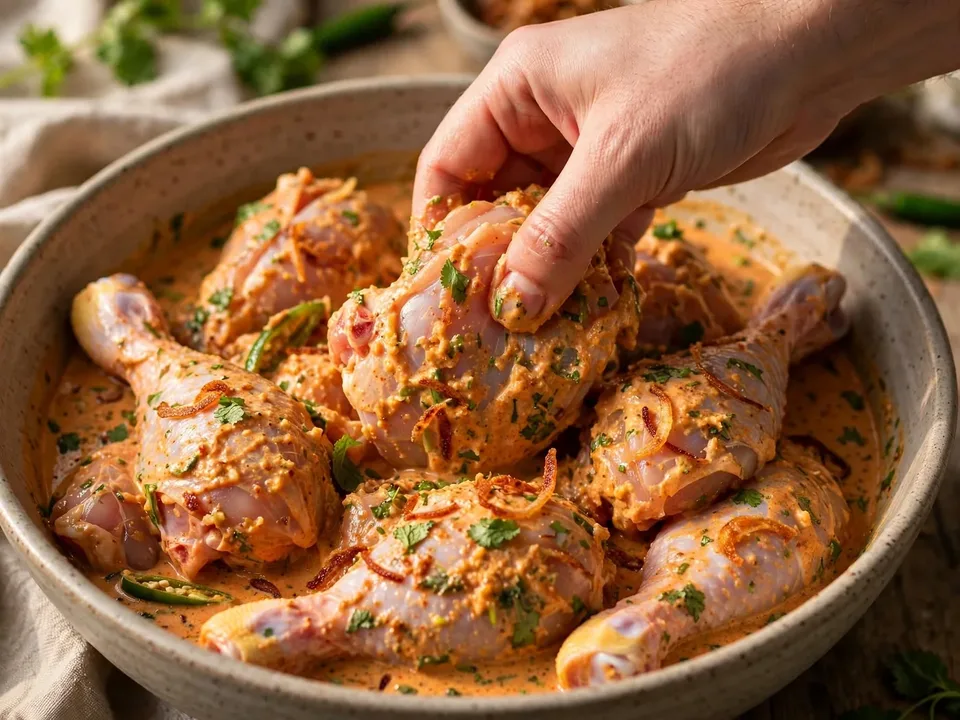
Pat the chicken dry and place it in a large non-reactive bowl. Add yogurt, ginger-garlic paste, green chillies, lemon juice, turmeric, Kashmiri chilli powder, garam masala, half the shahi jeera, the optional mace, about one-third of the finished birista, half the mint, half the cilantro, 3 tablespoons of the cooled onion-frying oil and enough salt to season the chicken thoroughly. Massage the marinade around every piece, cover and refrigerate for at least 2 hours; 4–6 hours gives better penetration. Keep it chilled until the rice is nearly ready.
Look for
Every piece should be evenly coated with a thick orange-red yogurt marinade, visible herbs and fried-onion strands, with no dry patches or watery liquid collecting at the bottom.
Kitchen note
The marinade should cling thickly to the chicken instead of pooling like a thin sauce. Bone-in thighs and drumsticks are especially forgiving during dum because they stay juicy while the rice finishes steaming.
 Step 02
Make deep-golden birista and bloom the saffron
20 min
If starting from raw onions, heat the neutral oil in a deep pan to about 160–170°C / 320–340°F.
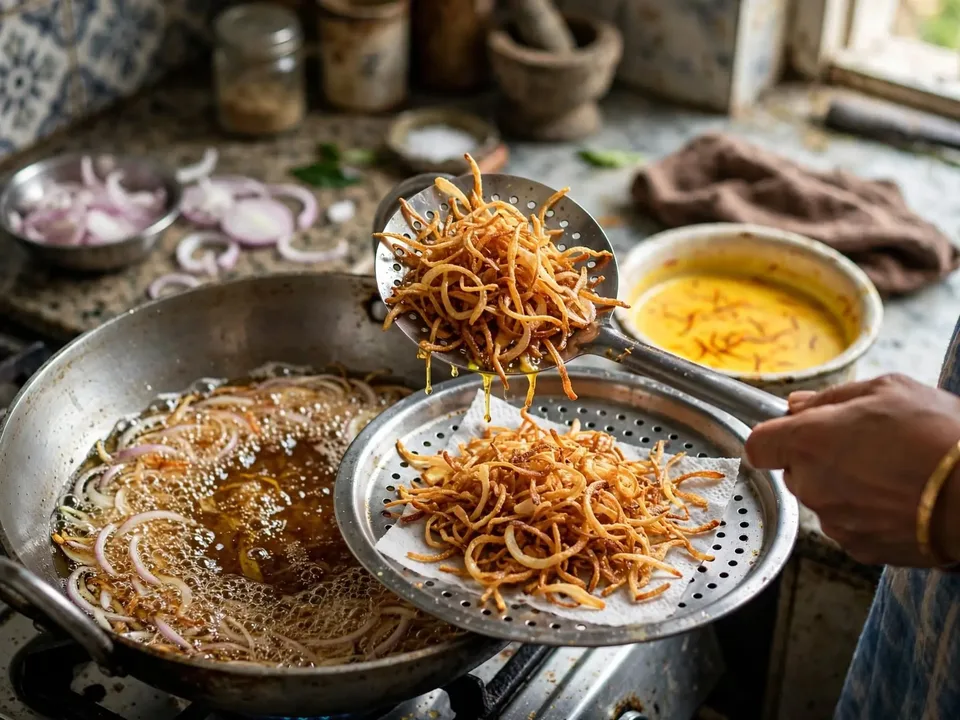
If starting from raw onions, heat the neutral oil in a deep pan to about 160–170°C / 320–340°F. Fry the very thin onion slices in batches, stirring so they colour evenly. Remove them when they are deep golden rather than dark brown; they will continue to darken slightly as they drain. Spread on a rack or absorbent paper until crisp. At the same time, soak the saffron in the warm milk for at least 10 minutes. Reserve about 3 tablespoons of the cooled onion oil for the marinade or layering.
Look for
The onions should be evenly deep golden, crisp after cooling and sweet-smelling rather than dark, bitter or greasy; the saffron milk should turn vivid yellow-gold.
Kitchen note
Birista goes from golden to burnt quickly. Pull the onions a shade lighter than the colour you ultimately want and never use blackened strands—the bitterness becomes concentrated inside the sealed pot.
 Step 03
Rinse and soak the basmati
35 min
Rinse the basmati gently several times until the water changes from milky to much clearer.
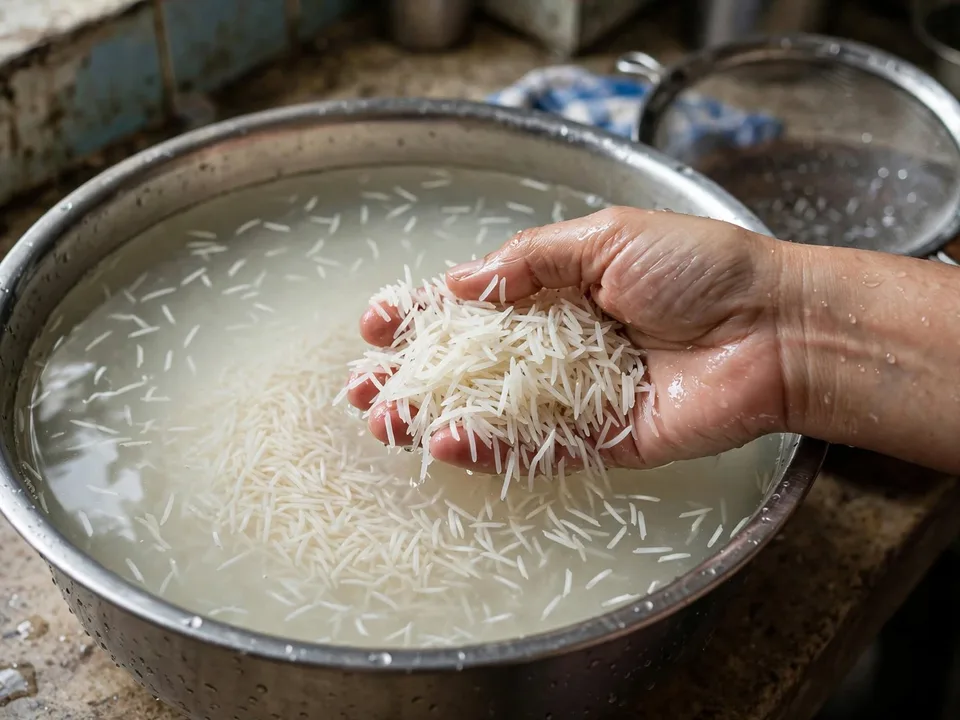
Rinse the basmati gently several times until the water changes from milky to much clearer. Cover with fresh water and soak for 30–45 minutes, then drain completely. Handle the soaked grains carefully because they are more fragile after hydration.
Look for
The soaked grains should look longer and opaque-white, and the final rinse water should be much clearer than the first without needing to become perfectly transparent.
Kitchen note
Soaking helps the grains elongate evenly and reduces the time they need in boiling water. Do not soak for hours: excessively hydrated rice is harder to keep separate through the later dum stage.
 Step 04
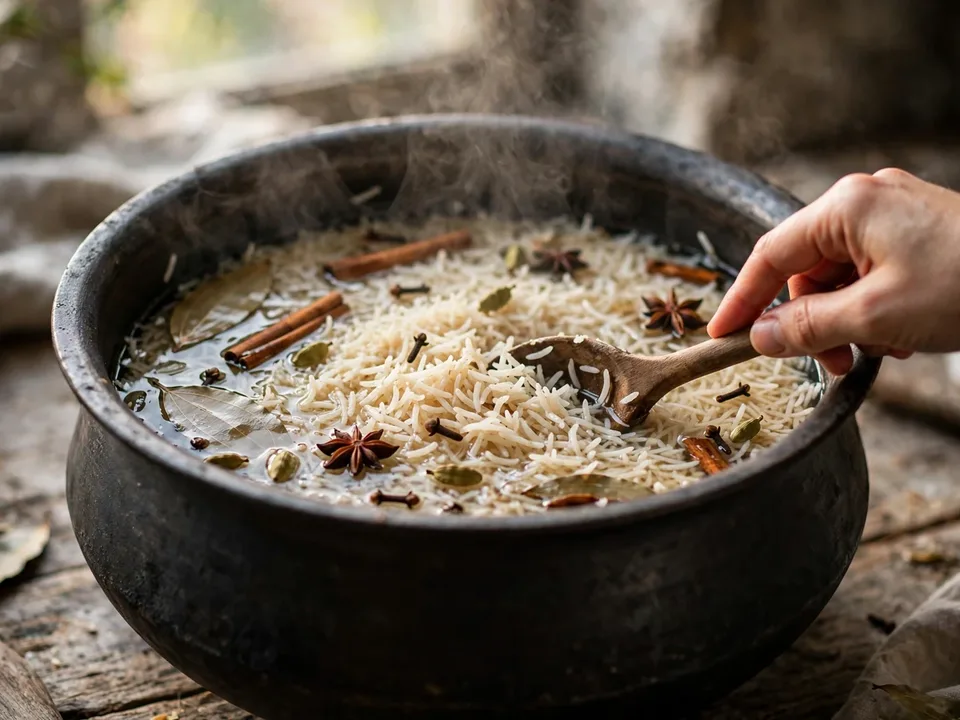
Par-cook the rice only to about 60–70%
10 min
Bring a large pot of water to a vigorous boil with the green cardamom, cinnamon, cloves, remaining shahi jeera and enough salt that the water tastes distinctly seasoned.
Bring a large pot of water to a vigorous boil with the green cardamom, cinnamon, cloves, remaining shahi jeera and enough salt that the water tastes distinctly seasoned. Add the drained soaked rice and boil uncovered, stirring only once or twice very gently. Begin checking early. Drain immediately when the grains are elongated and tender on the outside but still firm and slightly chalky at the centre—roughly 60–70% cooked. Spread the rice loosely so carryover heat does not push it to full doneness.
Look for
A grain should bend without snapping but still show a distinct firm white core when bitten or pressed; the exterior should not be mushy.
Kitchen note
This is the most important rice checkpoint. Fully cooked rice cannot survive another sealed steam cycle over raw chicken without turning soft, broken or clumpy. Drain the rice immediately at the stated par-cooked stage; if you wait until the grains are fully tender, they will overcook during dum and lose their separate structure.
 Step 05
Build the raw chicken base in a heavy handi
5 min
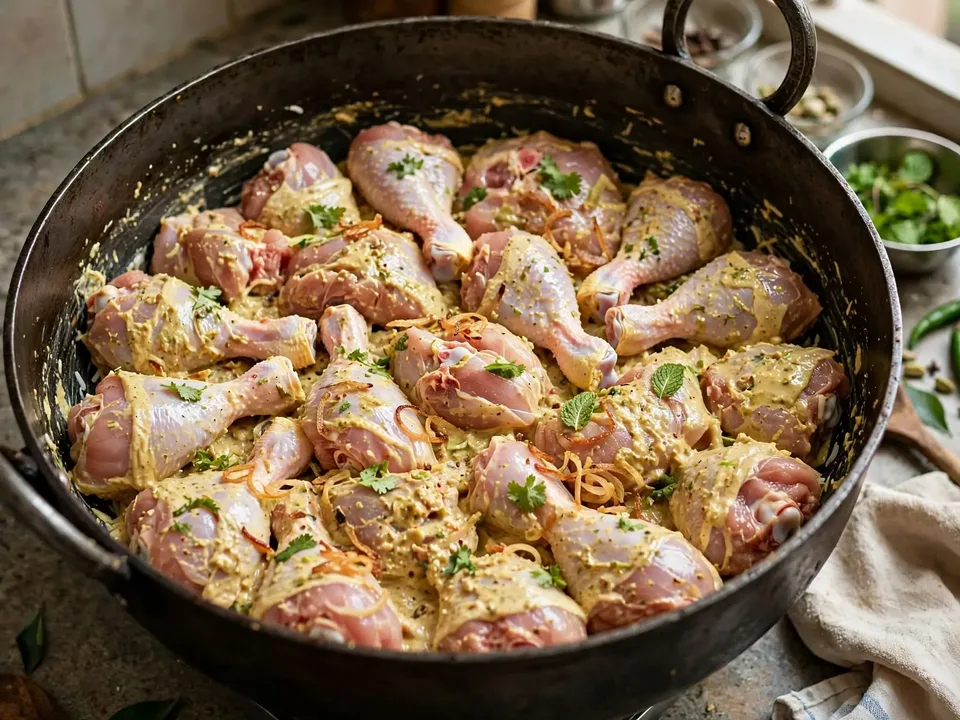
Use a heavy, wide-bottomed handi or Dutch oven with a tight-fitting lid.
Use a heavy, wide-bottomed handi or Dutch oven with a tight-fitting lid. Take the marinated chicken straight from the refrigerator and spread the raw pieces and all of their thick marinade across the bottom in one even layer. Keep larger bone-in pieces from stacking directly on top of one another so they cook at a similar rate. Scatter over a little birista, mint and cilantro, but keep most of the garnish for the rice layers.
Look for
The bottom of the handi should show one even layer of raw, heavily marinated chicken with no bare metal patches and no pieces piled into a tall mound.
Kitchen note
For this kachhi-style version, the chicken is deliberately raw at this point. Do not brown or pre-cook it—the meat and partially cooked rice are meant to finish together under trapped steam.
 Step 06
Layer the par-cooked rice, herbs and birista loosely
5 min
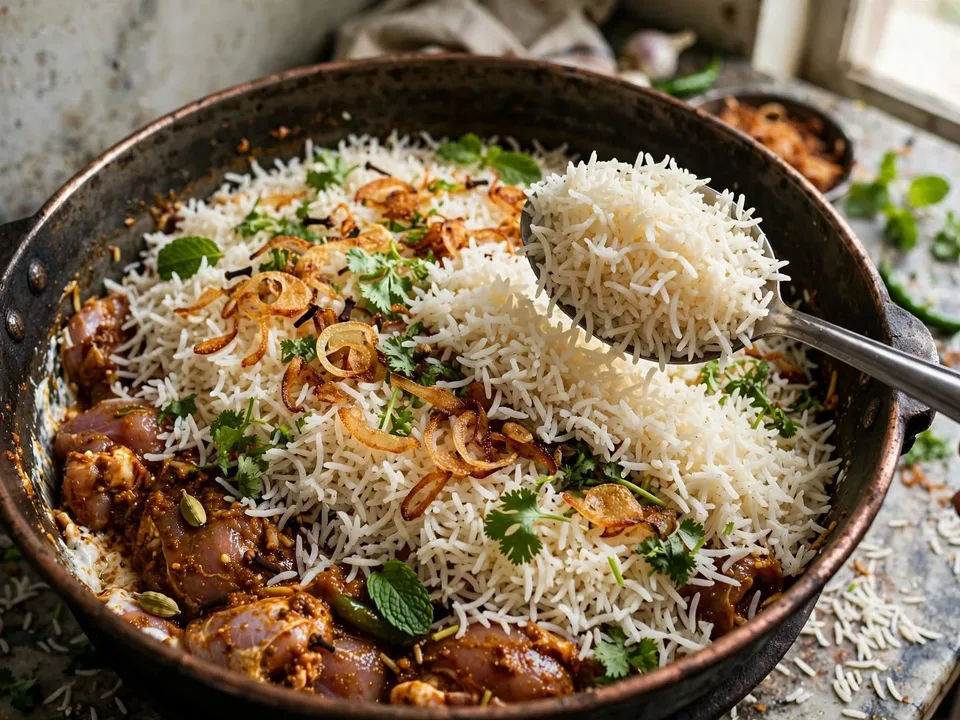
Spoon the drained par-cooked rice over the raw chicken without compressing it.
Spoon the drained par-cooked rice over the raw chicken without compressing it. Add it in two loose additions, scattering some birista, mint and cilantro between them so aroma is distributed rather than trapped only on top. Level gently with the back of a spoon, but never press down. Keep the grains airy so steam can travel from the chicken layer through the rice.
Look for
The rice should sit in a fluffy, unevenly coloured layer with visible herbs and birista, while individual grains remain separate instead of packed into a dense surface.
Kitchen note
Loose layering is functional, not decorative. Compressed rice slows steam circulation, encourages broken grains and makes the bottom cook much faster than the top.
 Step 07
Finish the top with saffron milk, ghee and aromatics
2 min
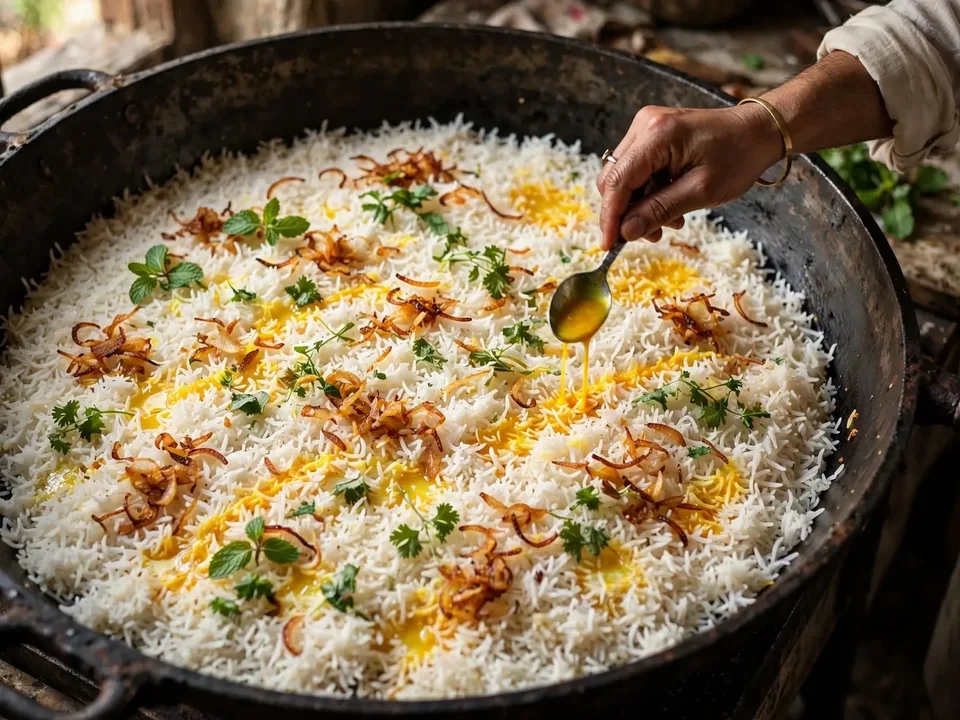
Drizzle the saffron milk over several different areas rather than colouring the whole surface.
Drizzle the saffron milk over several different areas rather than colouring the whole surface. Spoon over the melted ghee and scatter the remaining birista, mint and cilantro. If using kewra water, add no more than about 1 teaspoon in a few drops around the pot. The top should show white rice beside saffron-yellow and masala-tinted areas—the goal is layered aroma and colour, not uniformly orange rice.
Look for
The surface should remain mostly fluffy white rice with distinct saffron-gold streaks, fried onion and green herbs rather than looking wet or evenly dyed.
Kitchen note
Saffron and floral waters are accents. Too much saffron liquid can wet the rice, while too much kewra overwhelms the food with perfume. Restraint gives a more elegant biryani.
 Step 08
Seal the handi tightly for dum
5 min
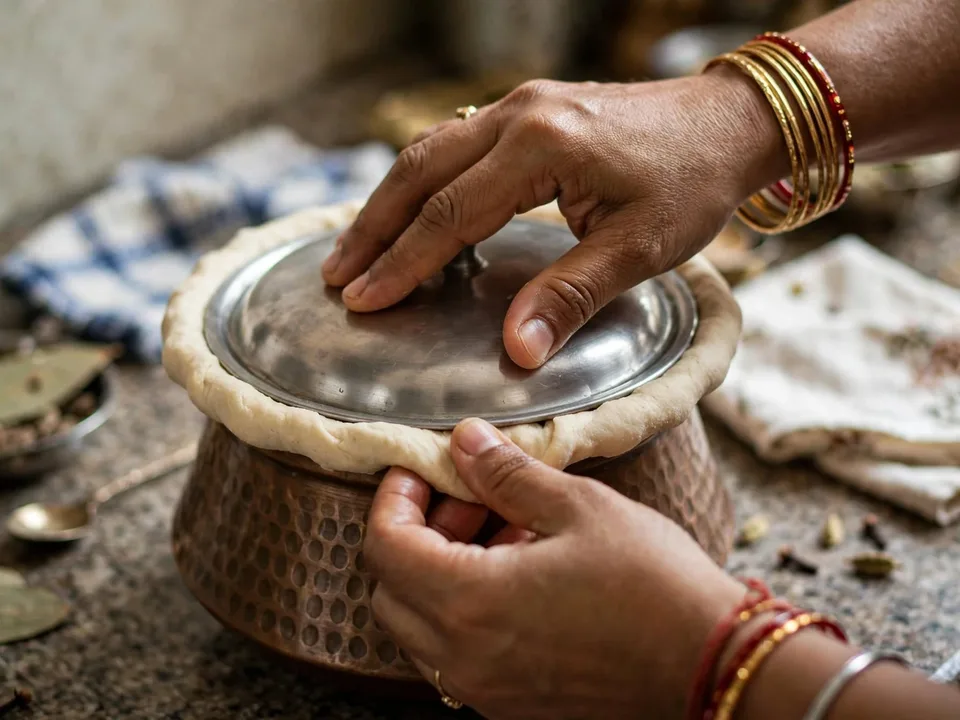
Run a rope of simple flour-and-water dough around the rim and press on the lid to make a tight seal.
Run a rope of simple flour-and-water dough around the rim and press on the lid to make a tight seal. If dough sealing is impractical, place a double layer of heavy foil across the pot before fitting the lid firmly. The objective is to trap enough steam to cook the raw chicken and finish the rice together, not to create a decorative seal.
Look for
The lid should sit firmly with the dough or foil closing the entire rim and no obvious open gaps where steam can escape freely.
Kitchen note
Check the lid fit before you start heating. A loose seal continuously leaks the steam the recipe relies on and can leave the top rice underdone while the bottom scorches. Seal gaps all the way around the lid. Escaping steam changes the dum timing, so repair any obvious leak before continuing rather than compensating with higher heat.
 Step 09
Build steam, then cook gently on dum
35 min
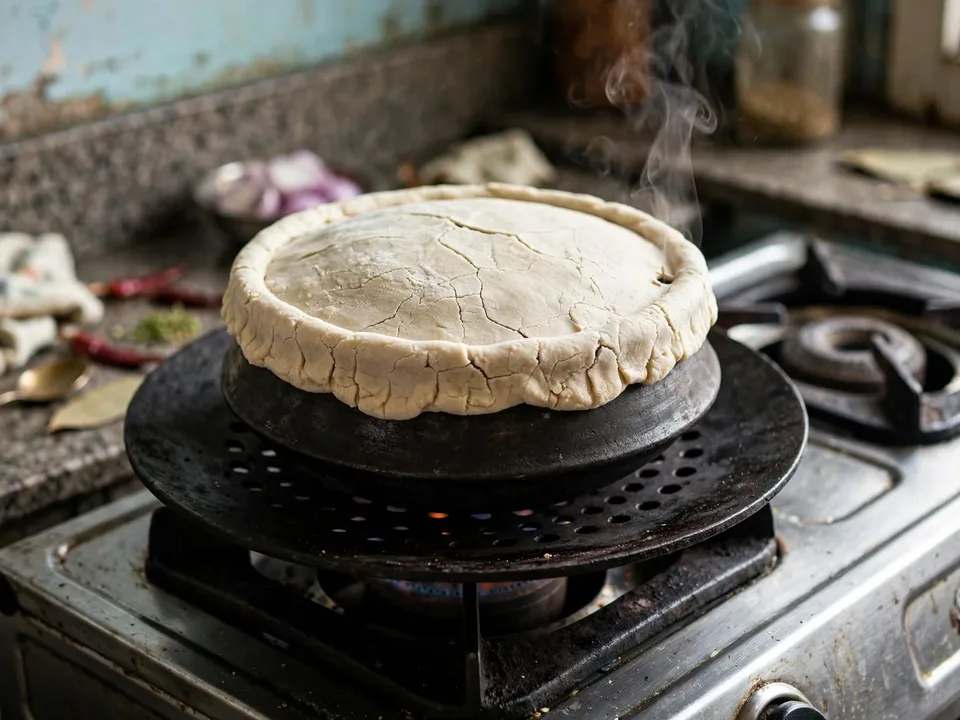
Set the sealed handi over medium heat for about 5–7 minutes to create a strong head of steam.
Set the sealed handi over medium heat for about 5–7 minutes to create a strong head of steam. Then immediately reduce to the lowest heat and continue cooking for about 25–30 minutes. If the pot is thin, the burner is fierce, or you are using gas, place a heavy tawa or heat diffuser underneath for the low-heat portion. Do not keep moving or opening the pot.
Look for
You may smell a strong biryani aroma and see wisps of steam at tiny seal gaps, but you should not hear aggressive frying or smell burning from the base.
Kitchen note
Dum is controlled trapped-steam cooking. The initial medium heat creates steam; the long low-heat phase cooks the chicken through without frying the bottom rice into a hard crust. If you are unsure about the heat, use the lowest flame that maintains trapped steam after the initial heat-up; dum should finish the rice gently, not scorch the chicken layer underneath.
 Step 10
Rest before opening, then verify rice and chicken
10 min
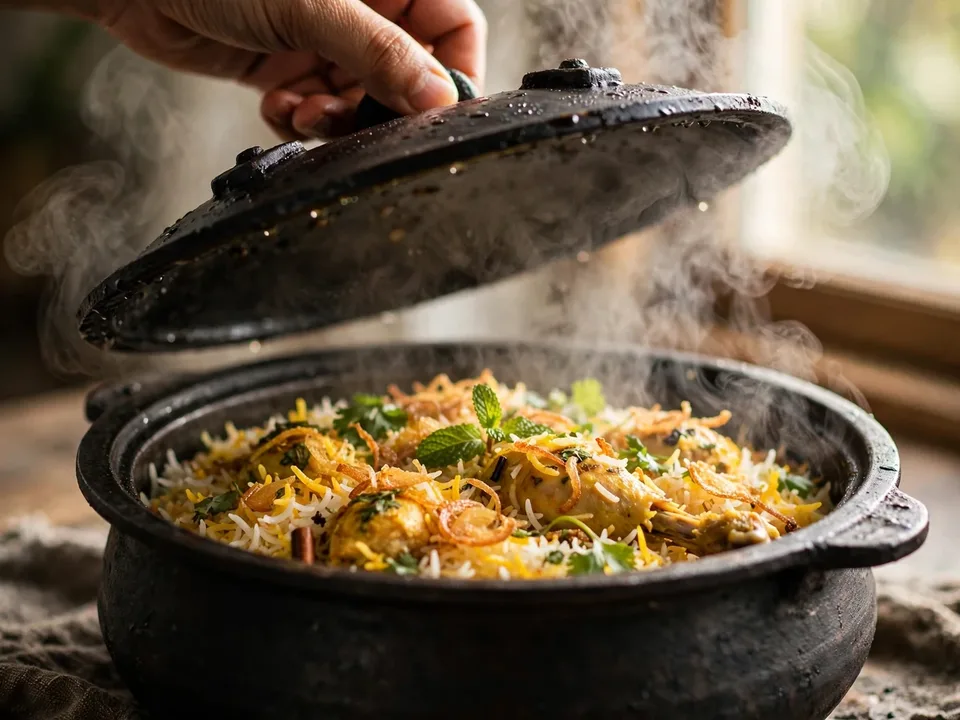
Turn off the heat and leave the sealed handi undisturbed for 10 minutes.
Turn off the heat and leave the sealed handi undisturbed for 10 minutes. Break the seal and lift the lid away from your face so trapped steam escapes safely. Check the rice: the grains should now be fully tender, long and separate. Check a thick chicken piece from the centre or bottom with an instant-read thermometer; it should reach at least 74°C / 165°F in the thickest meat away from bone. If the chicken is below that temperature or the rice still has a hard centre, reseal and return the pot to very low heat for another 5–10 minutes.
Look for
The opened pot should release fragrant steam; the rice should be separate and fluffy, and the chicken should be fully cooked and juicy rather than pink at the bone.
Kitchen note
Do not judge poultry safety by colour alone. In a kachhi biryani the chicken begins raw under the rice, so an instant-read thermometer is the most reliable final check. When opening, test rice from the top and chicken from the bottom. If the rice is still firm but the pot is dry, sprinkle a few tablespoons of hot water around the edge, reseal and give it a short additional dum.
 Step 11
Lift from the sides and bottom without stirring
4 min
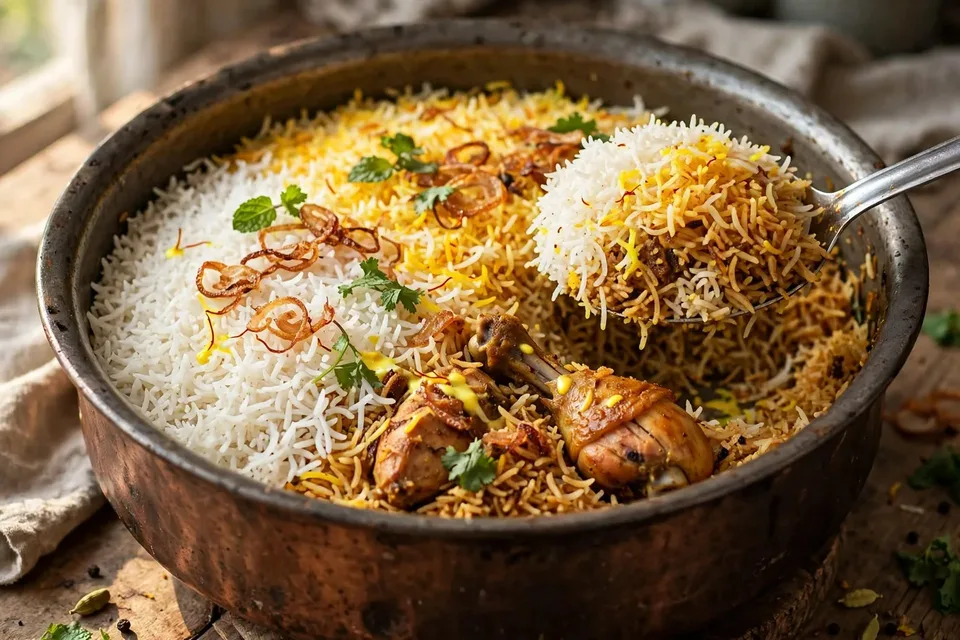
Use a broad serving spoon and work from the outer edge of the handi toward the bottom, lifting portions upward so each scoop contains rice from the top and seasoned chicken and masala from below.
Use a broad serving spoon and work from the outer edge of the handi toward the bottom, lifting portions upward so each scoop contains rice from the top and seasoned chicken and masala from below. Do not vigorously stir or fold the whole pot together. A few gentle lifts are enough to distribute the layers while preserving long basmati grains and contrasting colours.
Look for
A lifted spoonful should contain separate long grains in several colours plus moist seasoned chicken, without mashed rice or a wet curry pooling in the pot.
Kitchen note
Biryani should not become one uniformly orange rice mixture. Lifting rather than stirring preserves the contrast between white, saffron-yellow and masala-tinted grains and keeps the basmati intact.
 Step 12
Serve hot with cooling accompaniments
2 min
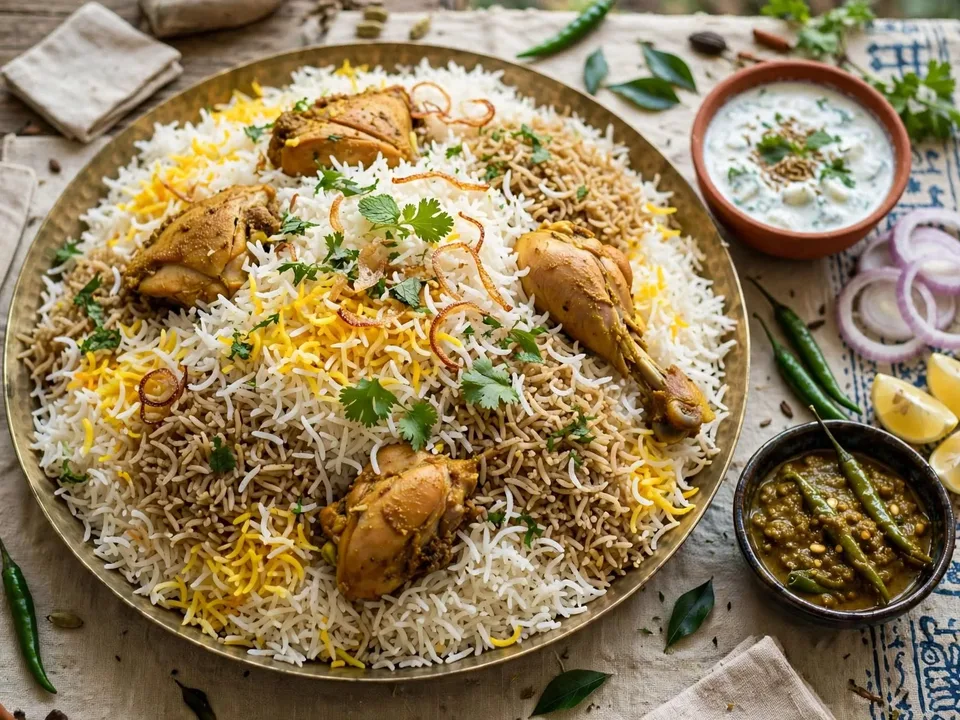
Transfer the biryani to a wide platter or serve directly from the handi, keeping the layers loose.
Transfer the biryani to a wide platter or serve directly from the handi, keeping the layers loose. Finish with a little reserved birista, mint or cilantro if desired. Serve immediately with raita; mirchi ka salan, bagara baingan, onion and lemon are common accompaniments. Avoid flooding the rice with sauce before serving—the grains should remain fragrant and separate.
Look for
The finished biryani should look dry-fluffy rather than wet, with long separate grains, juicy chicken and distinct white, saffron and masala-tinted patches.
Kitchen note
The best plate gives you fragrant rice, juicy chicken, fried-onion sweetness and fresh herbs in the same bite. Accompaniments should cool and sharpen the meal without hiding the biryani itself.
After cooking
Explore the dish beyond the method.
Story, place and references are here for discovery, so they stay out of the way while you cook.
Culture & tradition
The story behind the dish
Origins, evolution and everyday life—read together as part of the recipe's culinary record.
Origins
Hyderabadi biryani developed within the Deccan’s courtly and regional food traditions, combining rice, meat, aromatics and slow sealed cooking.
How it evolved
Kachhi and pakki approaches became distinct working methods, while households and restaurants developed their own spice balances, meat choices and accompaniments.
Its place today
The dish remains one of Hyderabad’s signature foods, served at celebrations, restaurants and family tables and closely associated with dum cooking.
Visual archive · plate 01
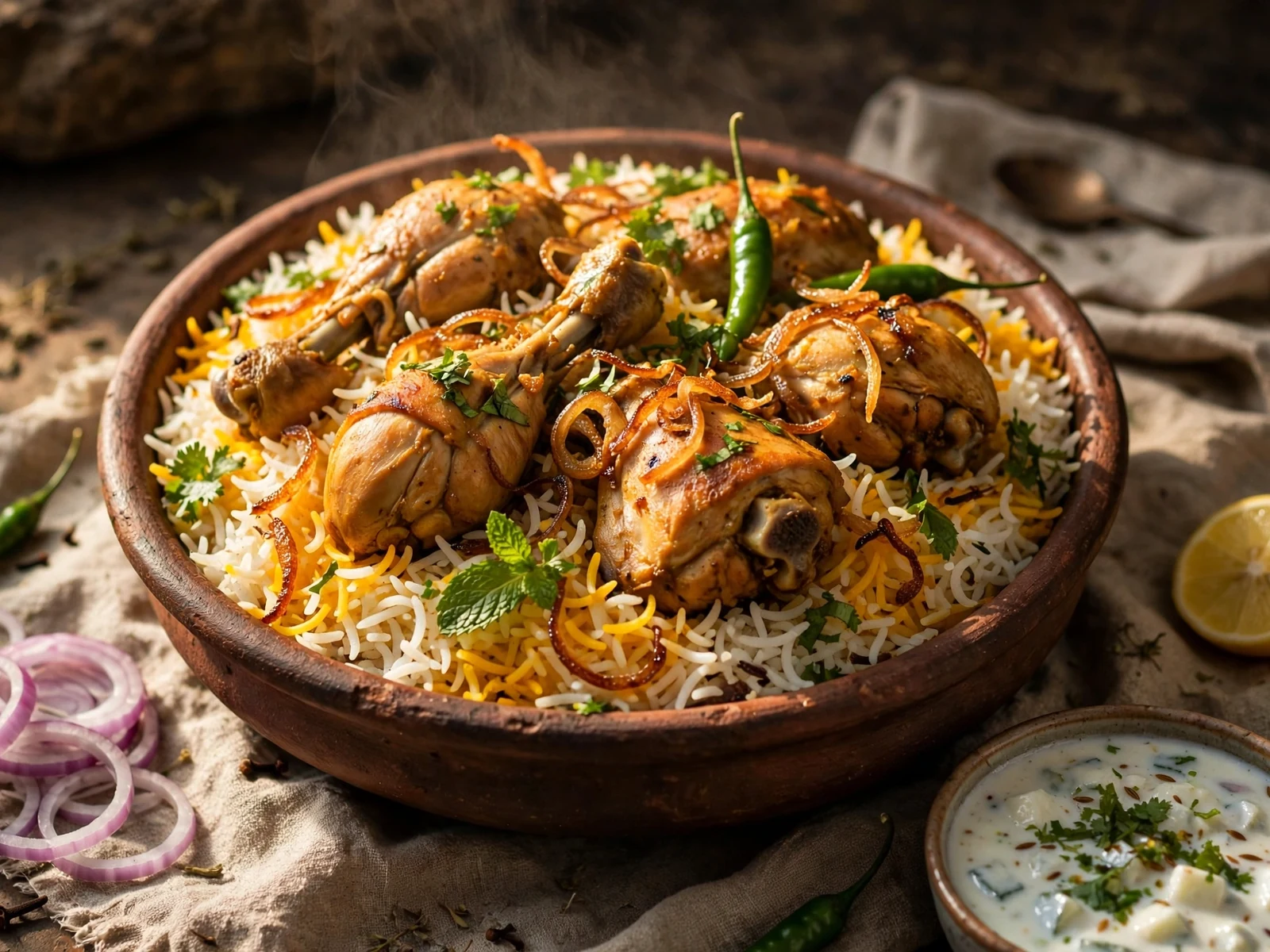
Hyderabadi Chicken Biryani
An editorial view of the finished dish, kept compact so the story continues without an oversized image break.
Primary region
Hyderabad, Telangana, Deccan Plateau
Country
India
Regional influence
Long-grain rice, aromatic spices, yogurt-marinated meat and sealed-pot cooking reflect the Deccan’s layered culinary history.
Related food systems
- Hyderabadi cuisine
- Dum cooking
- Rice-and-meat celebration dishes
Culinary record
- Sub-region
- South Asia — Indian Subcontinent
- Climate
- Monsoon
- Trade-route influence
- Spice Route · Mughal exchange · British colonial trade
Sources & further reading
Follow the reference trail.
Ember & Equator links outward when an institution or primary reference helps support the culinary record.
- 01Food and Cuisine — HyderabadExternal ↗
Incredible India, Ministry of Tourism, Government of India · government
Supports: Hyderabadi biryani · kachhi and pakki styles · dum cooking
Ember & Equator source review · 2026-09-16
- 02Hyderabadi Chicken Dum BiryaniExternal ↗
Chef Kunal Kapur · specialist publication
Supports: soaked basmati · marinated chicken · layering · sealed dum cooking · rest before opening
Ember & Equator source review · 2026-09-16
- 03Safe Minimum Internal Temperature ChartExternal ↗
USDA Food Safety and Inspection Service · government
Supports: poultry minimum internal temperature of 165°F / 73.9°C
Ember & Equator source review · 2026-09-16
- 04Difference between Pulao, Biryani and TahriExternal ↗
Chef Kunal Kapur · specialist publication
Supports: Hyderabadi kachhi biryani uses raw marinated meat with blanched rice and dum cooking
Ember & Equator source review · 2026-09-16
- 05Culinary Delight — Hyderabadi Dum BiryaniExternal ↗
Hyderabad District, Government of Telangana · government
Supports: Hyderabadi dum biryani identity · Hyderabad culinary context
Ember & Equator source review · 2026-09-16
Ingredient guides
Learn about the ingredients behind the dish.
These are reference guides, not a second ingredient list. Follow an ingredient when you want to understand its role, use and wider culinary context.
Ingredient
basmati rice
Understand what it contributes, how to use it, and the dishes that reveal it best.
Explore ingredient →
Ingredient
bone-in chicken
Understand what it contributes, how to use it, and the dishes that reveal it best.
Ingredient
plain yogurt
Understand what it contributes, how to use it, and the dishes that reveal it best.
Ingredient
yellow onion
Understand what it contributes, how to use it, and the dishes that reveal it best.
Ingredient
neutral oil
Understand what it contributes, how to use it, and the dishes that reveal it best.
Ingredient
ginger-garlic paste
Understand what it contributes, how to use it, and the dishes that reveal it best.
Keep wandering
Where will this dish take you next?
Stay with the place, follow an ingredient or technique, or cross into another food culture. Each path begins with something already present in this dish.
Stay with the place
01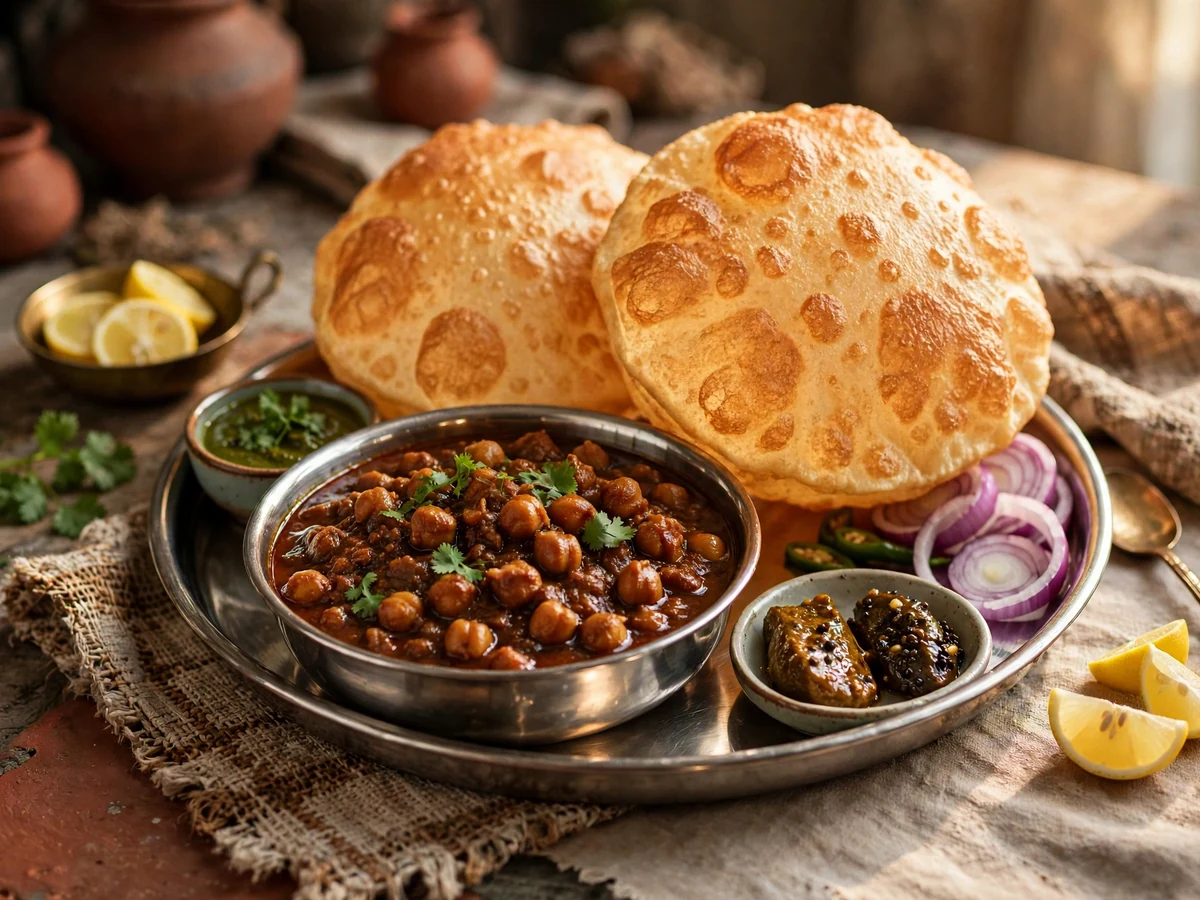
India
Chole Bhature
Stay in the same food culture and notice how fry appears in another dish.
Shared thread · Fry · plain yogurt · yellow onion
Follow the method or pantry
02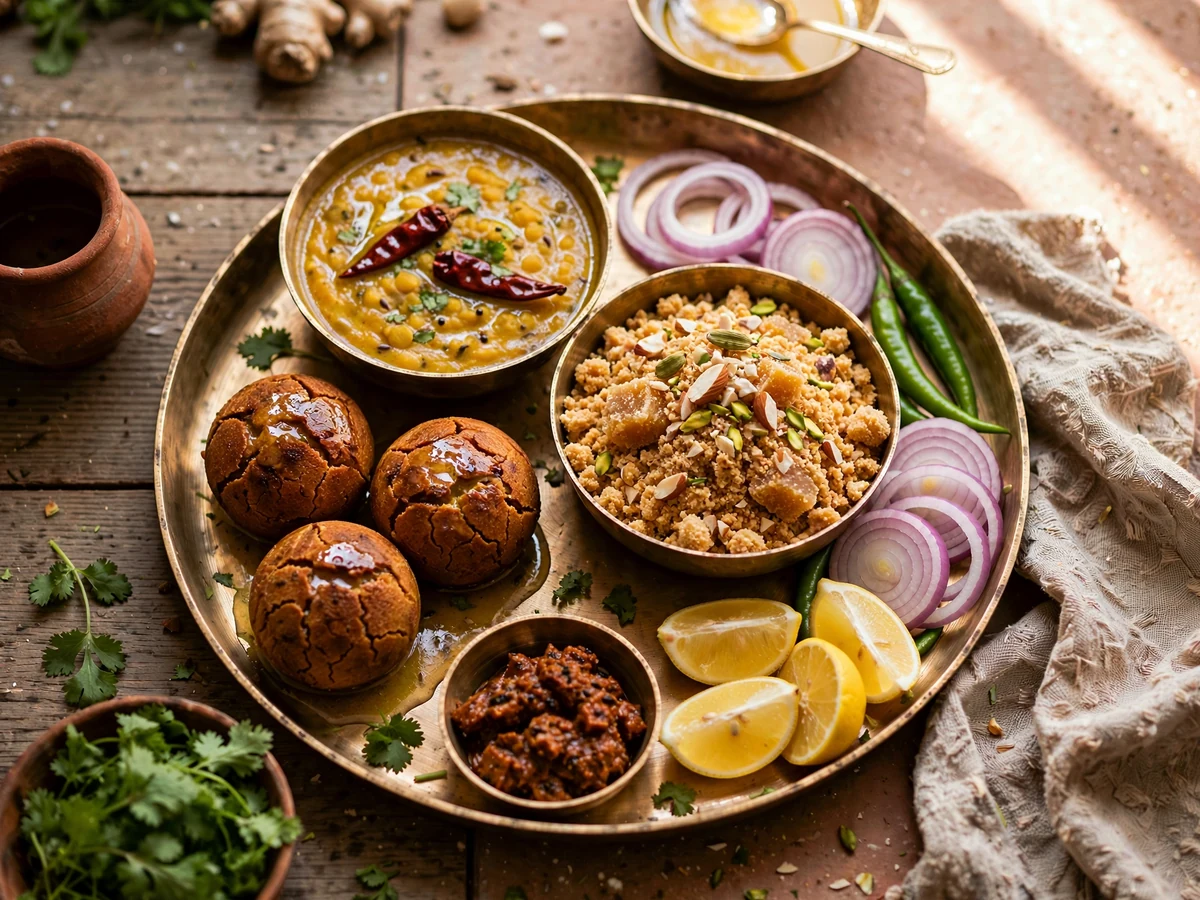
India
Dal Baati Churma
Follow the pantry: both dishes connect through yellow onion.
Shared thread · yellow onion · green chillies · lemon juice
Cross a culinary border
03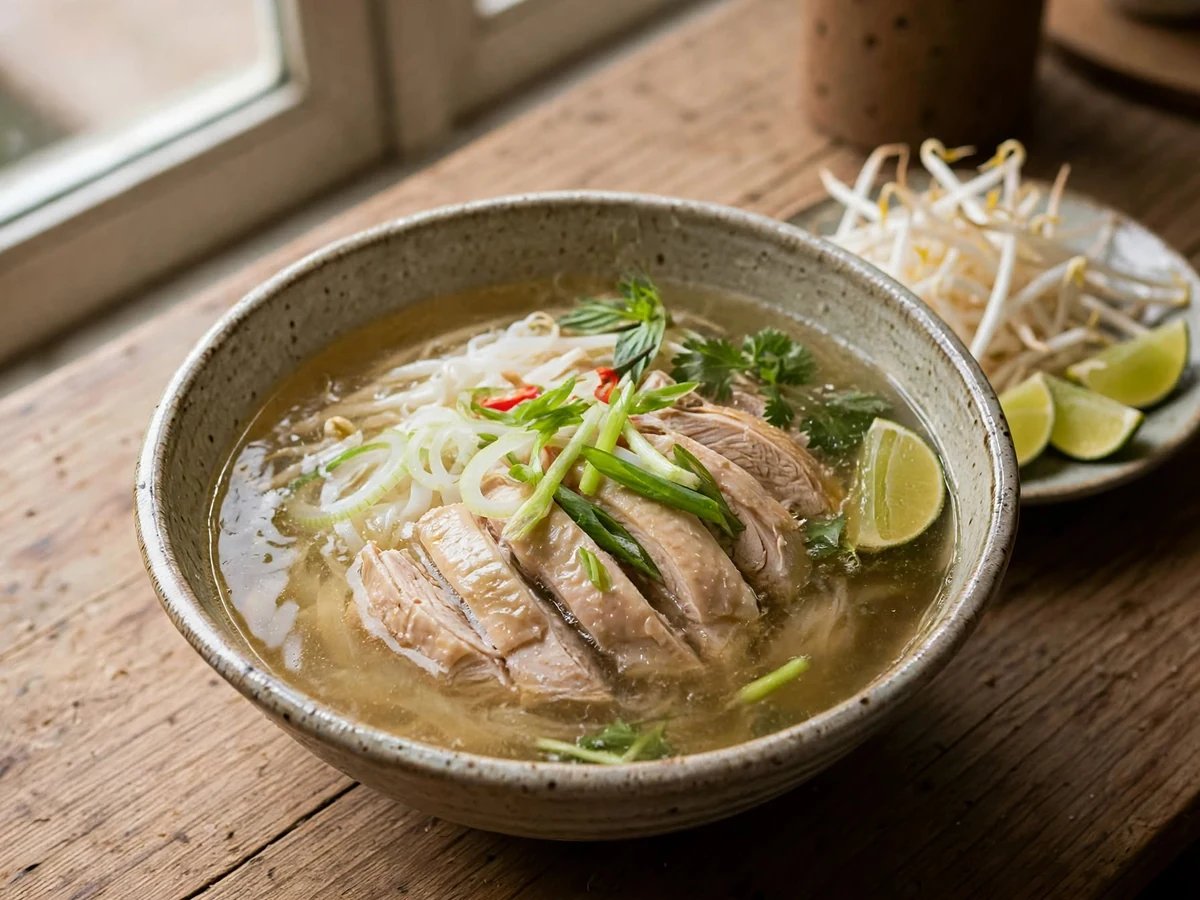
Vietnam
Phở Gà
Cross borders while keeping parboil as the common thread.
Shared thread · Parboil · bone-in chicken · yellow onion
Go one layer deeper
One small detail can open an entirely different part of food.
technique
Marinate
See why marinate matters here, then notice the same idea in other dishes.
technique
Dum cooking
See why dum cooking matters here, then notice the same idea in other dishes.
ingredient
saffron threads
See what saffron threads contributes to Hyderabadi Chicken Biryani, then follow it into other dishes.
Continue in Ember & Equator