
Thailand · lunch · dinner · street-food
Pad Thai
Thailand through one enduring dish.
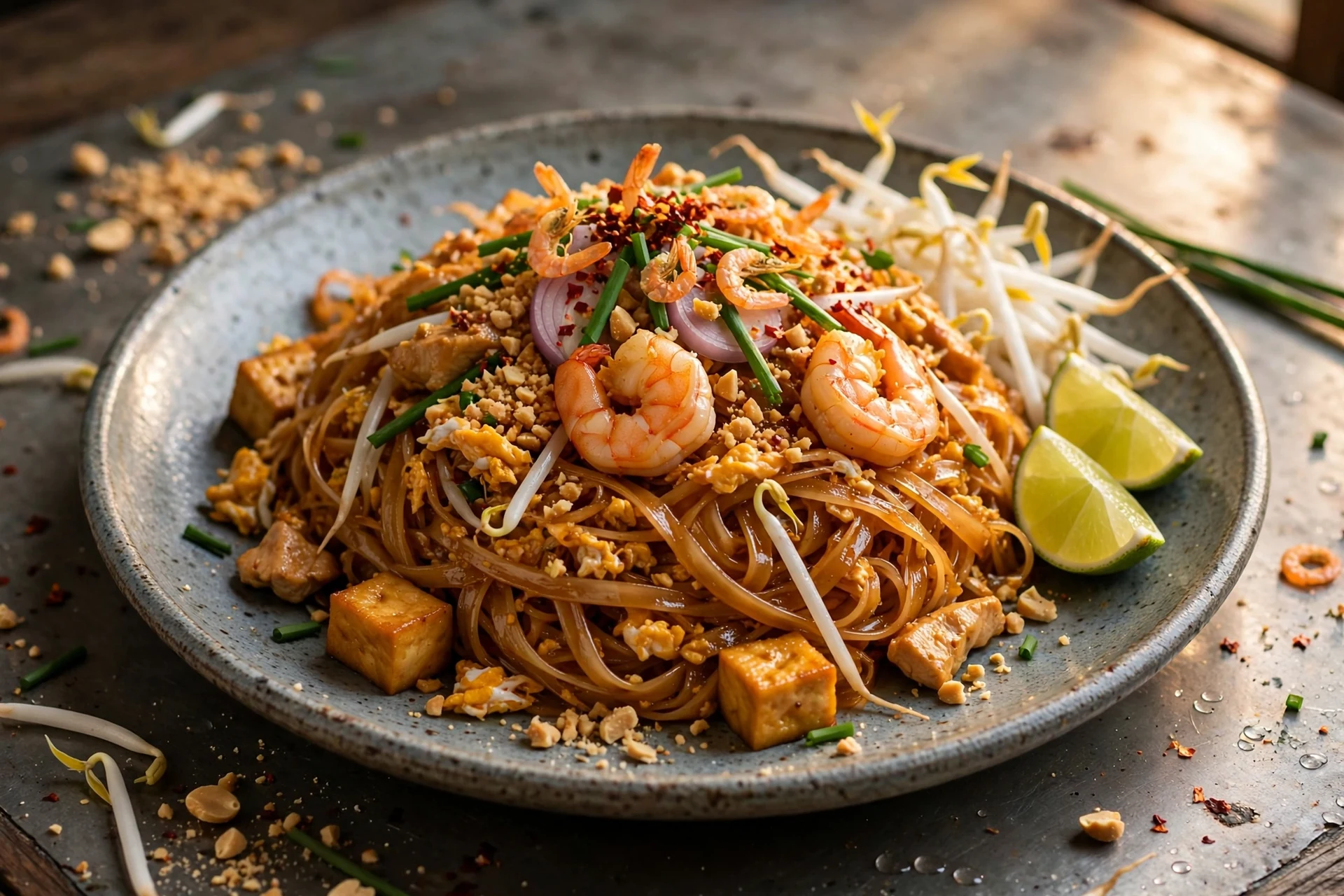
Pad Thai is a Central Thai wok-fried rice-noodle dish built around a concentrated tamarind, fish-sauce and palm-sugar seasoning, with tofu, egg, bean sprouts, garlic chives and roasted peanuts. This Ember & Equator version includes fresh prawns and dried shrimp, while the technique remains the real focus: hydrate the noodles correctly, work quickly over strong heat and finish them glossy rather than wet or sticky.
- Total
- 46 min
- Difficulty
- Medium
- Serves
- 3
- Steps
- 7
The dish
Place first. Then the plate.
Pad Thai is closely associated with Central Thailand and Bangkok street-food and made-to-order cooking. Its modern national prominence developed in twentieth-century Thailand, while the dish also reflects older Chinese-influenced noodle and wok traditions. Ingredient combinations vary, but tamarind-led sourness, fish-sauce salinity, palm-sugar sweetness, rice noodles, egg, tofu, sprouts and chives are recurring anchors.
Explore ThailandAt a glance
Origin
Bangkok
Region
Central Thailand / Bangkok
Method
stir-fried
Meal
lunch · dinner · street-food
Guided steps
7
Dish
Pad Thai
Cuisine
Thai cuisine
Food type
Noodle dish · Street food · Lunch
Technique
Wok stir-fry · Balance a sweet-sour-salty sauce · Fold
Cook the recipe
In the kitchen
Start with the ingredients, then follow the Method in order. Open cooking tips only when you need extra help; the story and references can wait until you are ready.
- Total
- 46 min
- Serves
- 3
- Level
- Medium
- Visual cues
- 7
Ingredients
Serves 3- 200 gdried flat rice noodlesmedium-width Pad Thai noodles; soak, do not boil until soft
- 180 graw prawnspeeled and deveined; this recipe uses the common prawn variation
- 120 gfirm tofucut into small batons or cubes
- 25 gdried shrimproughly chopped if large
- 2 tbspsweet preserved radishfinely chopped; rinse briefly if extremely salty
- 2 smallshallotsthinly sliced
- 2 largeeggslightly beaten only if preferred; they can also be cracked directly into the wok
- 120 gbean sproutskeep a small handful raw for serving if desired
- 60 ggarlic chivescut into 4 cm lengths
- 3 tbsptamarind concentratestrength varies by brand; dilute if very concentrated
- 2 tbspfish sauceadd carefully because dried shrimp and preserved radish are also salty
- 2 tbsppalm sugarfinely chopped or grated
- 3 tbspneutral oilfor high-heat wok cooking
- 40 groasted peanutsroughly crushed
- 1 wholelimecut into wedges for serving
Optional
- 1 tspdried red chilli flakesor to taste, for serving
Everything ready? Continue straight into the cooking steps.
Start methodMethod
7 steps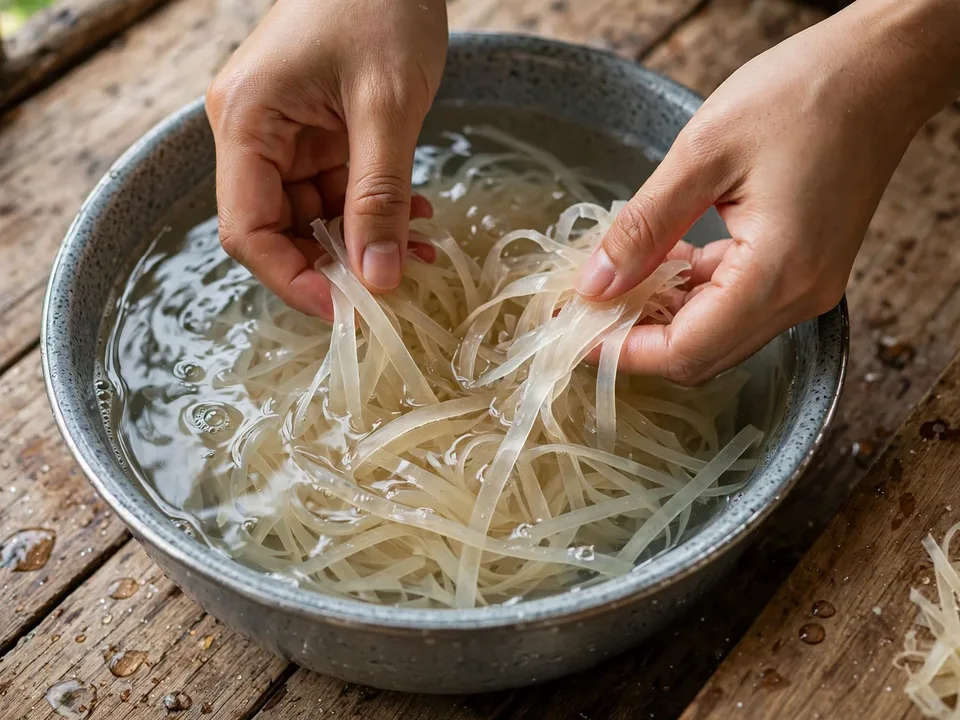 Step 01
Soften the noodles without fully cooking them
35 min
Place the dried rice noodles in plenty of room-temperature water and soak until they are fully pliable but still clearly undercooked at the centre, usually about 30–60 minutes depending on the brand and thickness.
Place the dried rice noodles in plenty of room-temperature water and soak until they are fully pliable but still clearly undercooked at the centre, usually about 30–60 minutes depending on the brand and thickness. Lift one strand and bend it around your fingers: it should flex without snapping but should not yet have the soft bite of finished noodles. Drain extremely well and keep beside the stove. Do not boil the noodles tender before stir-frying; they must finish cooking as they absorb the Pad Thai sauce.
Look for
The strands bend easily and separate from one another, but a bitten noodle still has a firm opaque core rather than a fully tender centre.
Kitchen note
The noodles should enter the wok flexible but underdone. If they are already soft enough to eat after soaking, they are much more likely to turn gummy or break during the stir-fry. Have the sauce, drained noodles, egg, protein, sprouts, chives and garnishes beside the wok before heating it; once cooking starts there is no useful pause for chopping or measuring.
 Step 02
Prepare and balance the three-flavour sauce
4 min
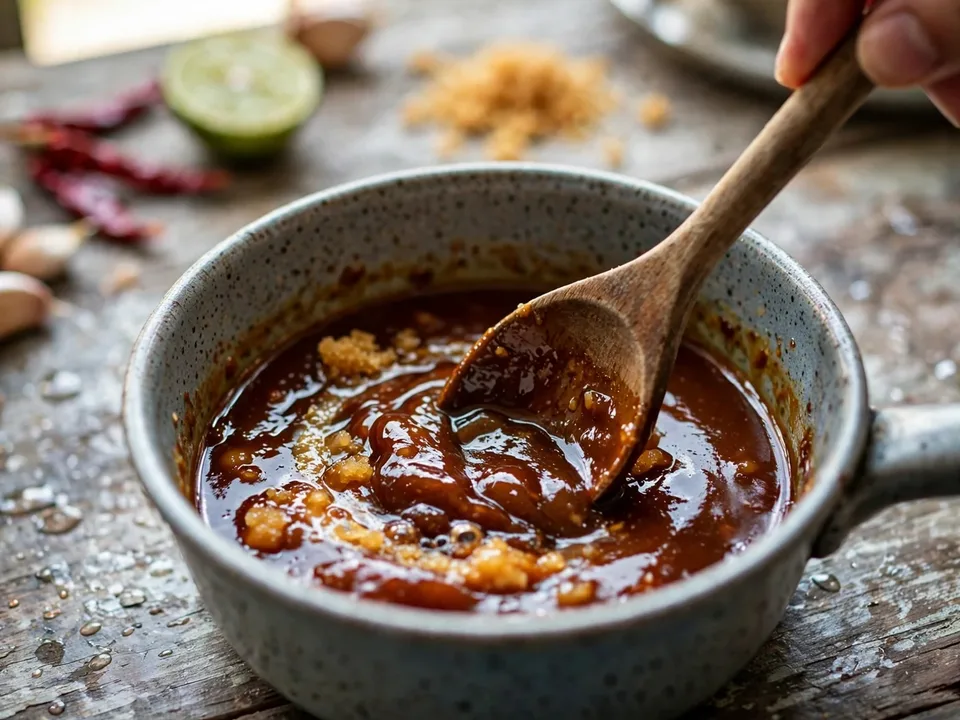
Combine the tamarind concentrate, fish sauce and palm sugar in a small saucepan.
Combine the tamarind concentrate, fish sauce and palm sugar in a small saucepan. Warm gently, stirring until the palm sugar is completely dissolved and the sauce is smooth and pourable; do not reduce it into a thick syrup. Taste before the wok stage. It should register clearly as sour, salty and sweet and can taste slightly more intense than you ultimately want because the noodles, tofu and egg will soften the seasoning. Tamarind concentrates vary greatly, so correct the balance now rather than trying to rescue the entire wok later.
Look for
The sugar is fully dissolved and the sauce is glossy and fluid, with no gritty crystals and no sticky caramel-like reduction.
Kitchen note
Pad Thai does not need ketchup for colour or sweetness. The classic flavour structure comes from tamarind, fish sauce and palm sugar.
 Step 03
Sear the prawns, then build the savoury wok base
4 min
Have every remaining ingredient measured and within reach before heating the wok; once cooking starts, the sequence moves quickly.
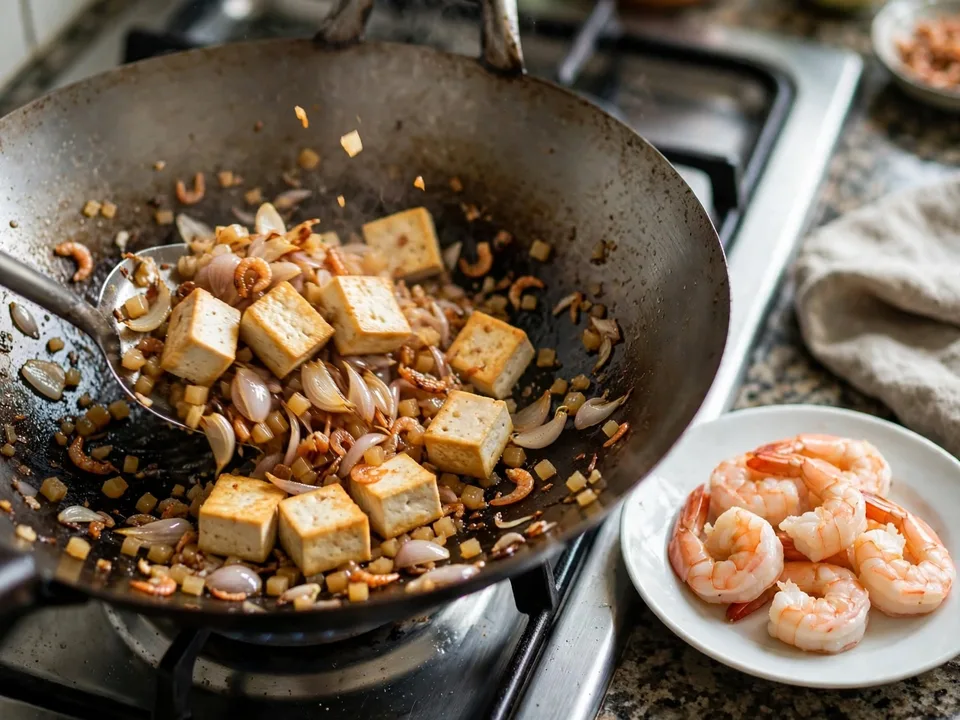
Have every remaining ingredient measured and within reach before heating the wok; once cooking starts, the sequence moves quickly. Pat the prawns dry. Heat a wok or very wide skillet until hot, add enough oil to coat the base and sear the prawns just until opaque and cooked through, usually about 60–90 seconds per side depending on size. Remove them to a plate immediately. In the same wok, add a little more oil if needed, then stir-fry the shallots, tofu, dried shrimp and sweet preserved radish until the shallots are wilted, the tofu has light golden edges and the preserved ingredients smell deeply savoury.
Look for
The prawns are just opaque and springy, the tofu has some golden edges, and the shallots are softened and fragrant without a pool of released liquid.
Kitchen note
Cooking the prawns first and setting them aside is a practical home-wok technique that protects them from overcooking while the noodles finish. Do not crowd the wok; if the ingredients steam instead of sizzle, let the pan recover its heat.
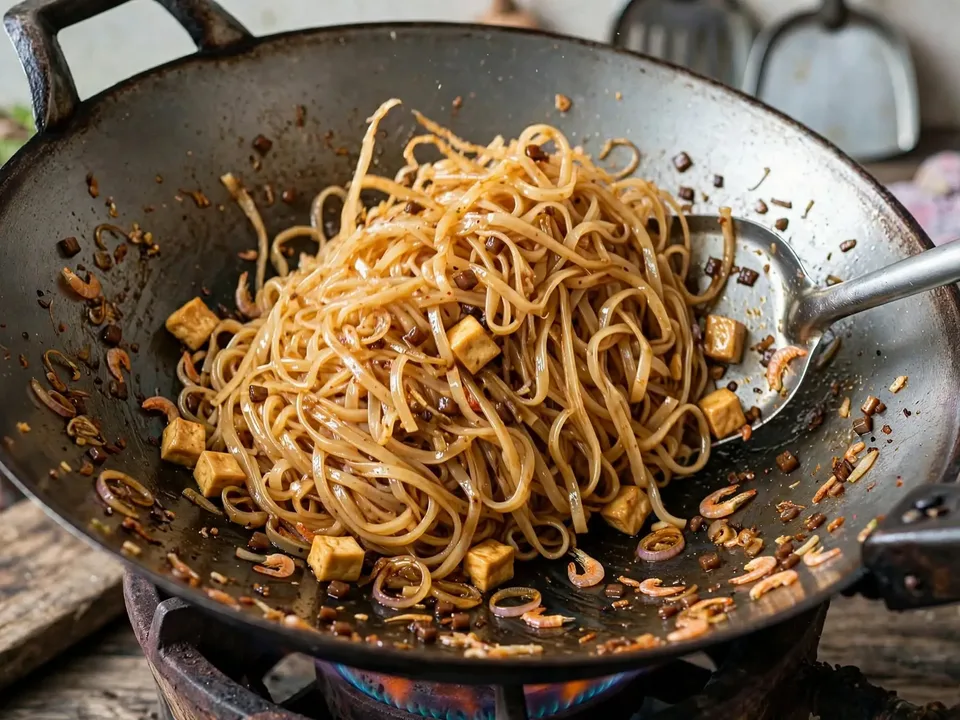 Step 04
Add the noodles and sauce and fry until absorbed
4 min
Add the thoroughly drained noodles to the aromatic tofu mixture, then pour in the prepared Pad Thai sauce.
Add the thoroughly drained noodles to the aromatic tofu mixture, then pour in the prepared Pad Thai sauce. Toss and turn continuously over medium-high to high heat so the strands are coated evenly and soften as they absorb the sauce. Separate clumps with the edge of a spatula or tongs rather than crushing the noodles. When the visible sauce has mostly disappeared, taste a strand. If the centre is still too firm, add only 1–2 tablespoons of water, toss until absorbed and reassess before adding more.
Look for
The noodles look glossy and evenly brown from the sauce, are tender-chewy rather than hard, and almost no free liquid remains at the bottom of the wok.
Kitchen note
Water is a correction tool, not a sauce ingredient at this stage. Add it in spoonfuls only when the noodles need more hydration; a large splash can turn the wok into a braise and make the noodles soggy.
 Step 05
Set the egg into the noodles and return the prawns
2 min
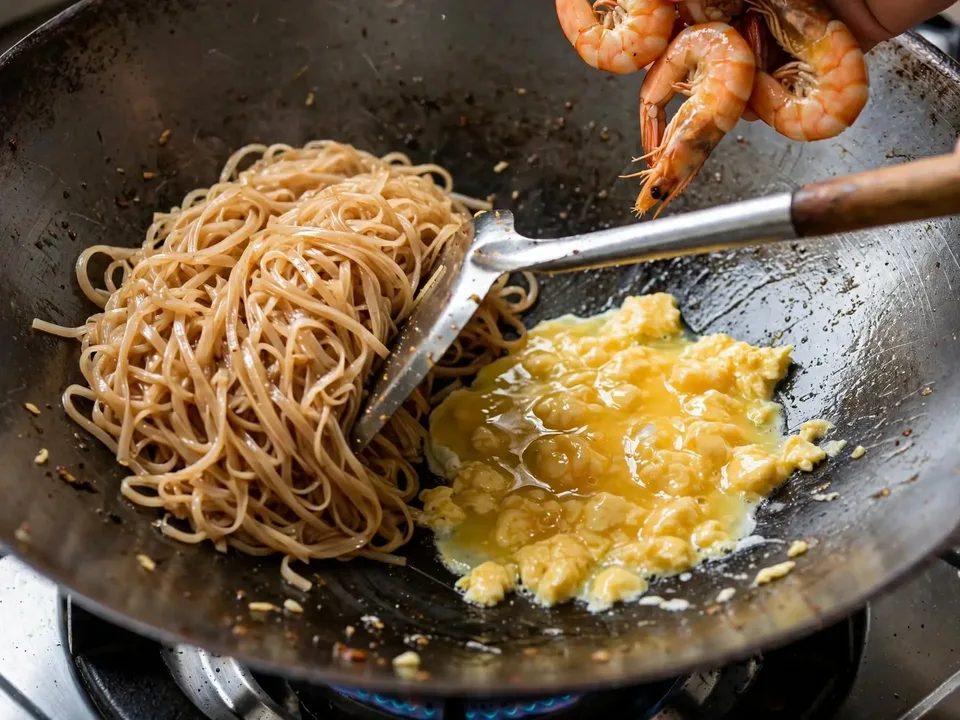
Push the noodles to one side of the wok and add a small film of oil to the exposed surface if it looks dry.
Push the noodles to one side of the wok and add a small film of oil to the exposed surface if it looks dry. Crack in the eggs. Let the bottoms set for roughly 10–15 seconds, break the yolks and gently move the egg into soft curds while the tops are still glossy. Fold the noodles over the egg and toss just enough to distribute ribbons of tender egg through the strands. Return the cooked prawns now and toss only until they are hot again.
Look for
The egg forms soft yellow ribbons attached to the noodles, while the returned prawns stay plump rather than tightening into small hard curls.
Kitchen note
Do not scramble the egg dry before it meets the noodles. Slightly moist egg finishes cooking from the heat of the noodles and gives Pad Thai tender ribbons rather than hard, rubbery pieces. If the noodles are still firm after the sauce is absorbed, add water one tablespoon at a time and keep tossing; if they are already soft, do not add more liquid just because the pan looks dry.
 Step 06
Fold in the sprouts and garlic chives at the last moment
1 min
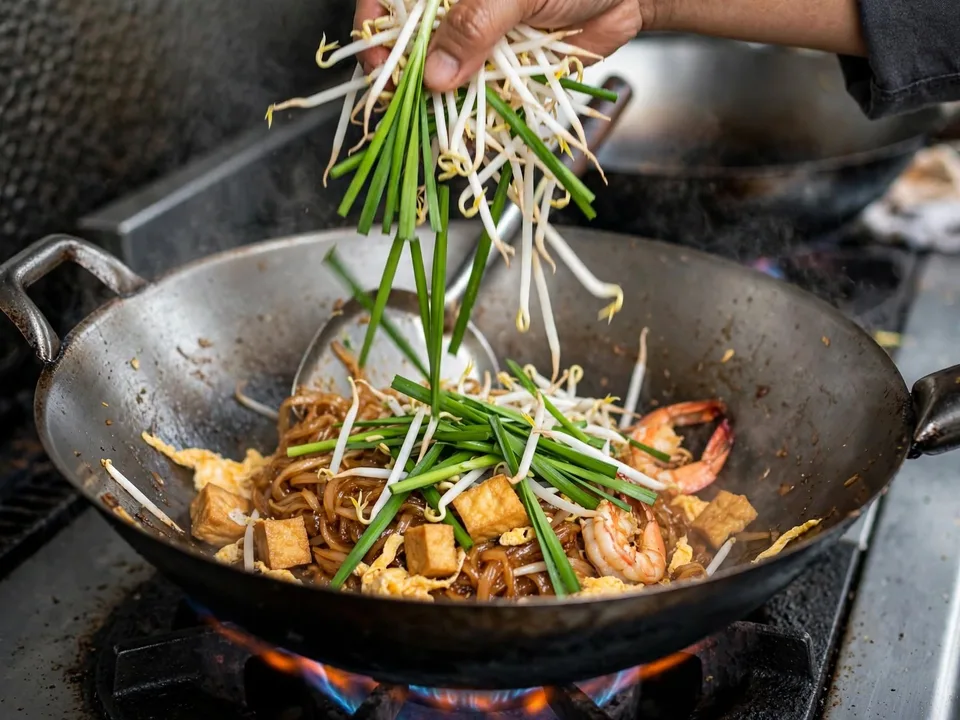
When the noodles are fully seasoned and correctly tender, add most of the bean sprouts and garlic chives.
When the noodles are fully seasoned and correctly tender, add most of the bean sprouts and garlic chives. Toss for only 30–60 seconds—long enough to warm them and distribute them through the noodles, but not long enough to wilt them completely. Take the wok off the heat as soon as the sprouts lose their raw chill while retaining crunch and the chives remain vivid green.
Look for
The sprouts remain pale, crisp and juicy, the chives stay bright green, and the noodles remain loose and glossy rather than clumped.
Kitchen note
Fresh crunch is part of Pad Thai’s texture. Reserve a small handful of raw sprouts for the table if you want even more contrast.
 Step 07
Plate immediately and finish at the table
2 min
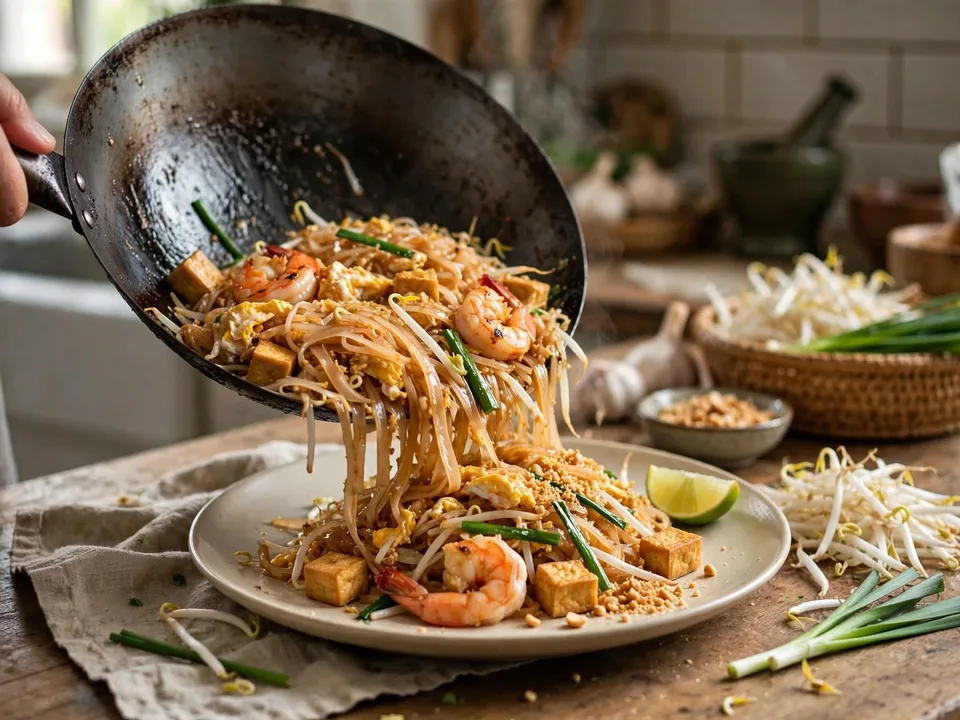
Transfer the Pad Thai to warm plates as soon as it leaves the wok.
Transfer the Pad Thai to warm plates as soon as it leaves the wok. Scatter with roasted crushed peanuts and serve with lime wedges, extra bean sprouts, garlic chives and dried chilli flakes as desired. Let each diner squeeze lime and add extra chilli at the table so the wok seasoning remains balanced. Pad Thai should arrive hot, aromatic and loose enough that individual noodles lift cleanly rather than sticking together in a heavy mass.
Look for
The plate shows separate glossy noodles, tender egg ribbons, crisp sprouts, golden tofu and juicy prawns, with no puddle of watery sauce underneath.
Kitchen note
Pad Thai waits badly. The noodles keep absorbing moisture as they sit, so the correct texture in the wok is your cue to plate immediately.
After cooking
Explore the dish beyond the method.
Story, place and references are here for discovery, so they stay out of the way while you cook.
Culture & tradition
The story behind the dish
Origins, evolution and everyday life—read together as part of the recipe's culinary record.
Origins
Pad Thai’s modern identity is strongly associated with twentieth-century Thailand, particularly the period when noodle eating was promoted nationally. Its name and method also reflect Chinese-influenced rice-noodle and wok traditions adapted to Thai tastes.
How it evolved
Over time, cooks developed many versions using dried shrimp, tofu, egg, preserved radish, prawns or other proteins. The characteristic sweet-sour-salty balance and quick wok finish remained more important than any one fixed garnish list.
Its place today
Today Pad Thai is one of Thailand’s best-known street and restaurant dishes, commonly cooked to order and served immediately with crunchy sprouts, peanuts, lime and chilli for diners to adjust at the table.
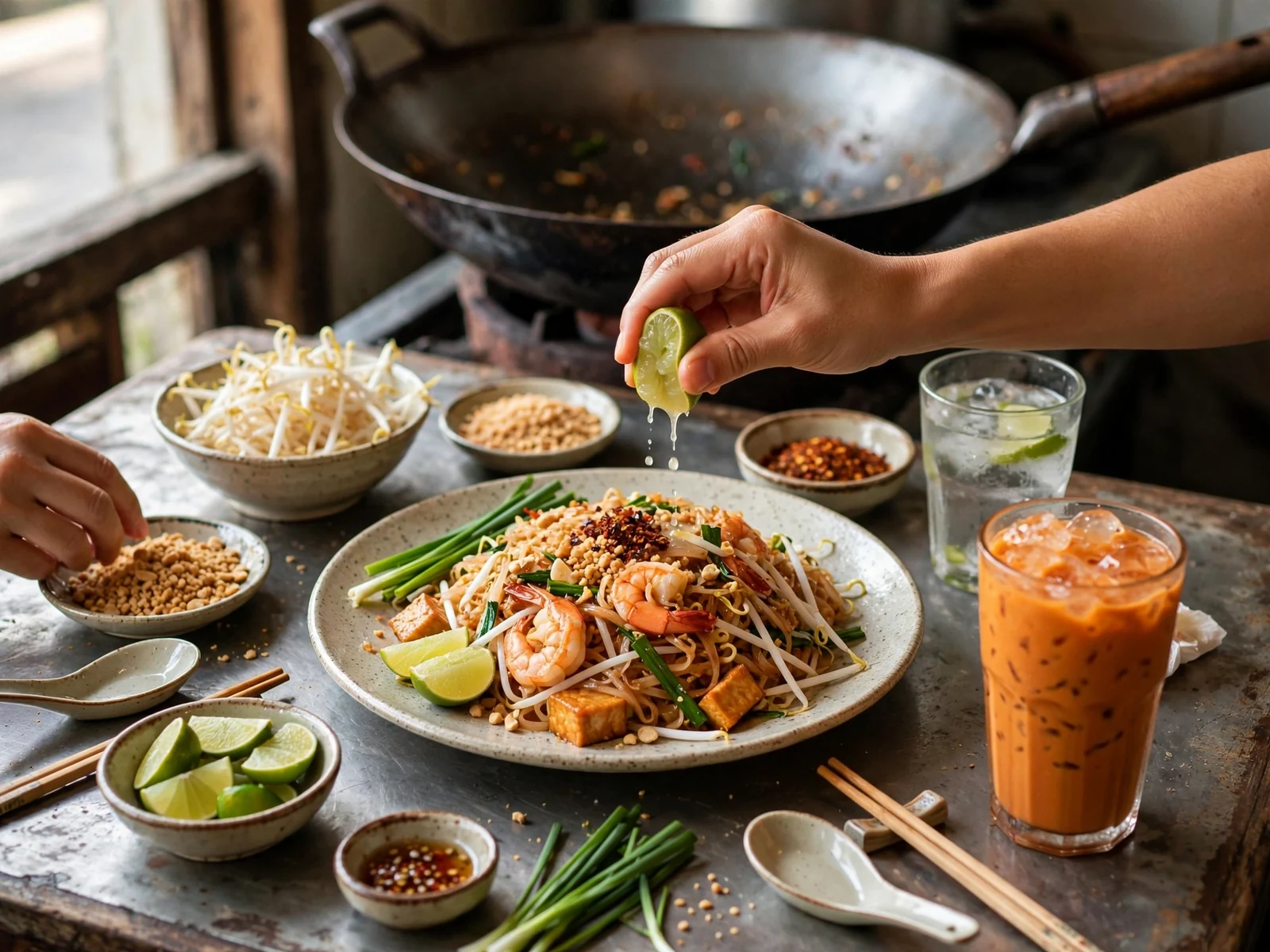
Visual archive · plate 01
Pad Thai
An editorial view of the finished dish, kept compact so the story continues without an oversized image break.
Primary region
Central Thailand / Bangkok
Country
Thailand
Regional influence
Central Thailand’s rice-growing landscape and urban made-to-order food culture both shape the dish: dried rice noodles are shelf-stable, while lime, herbs, sprouts and aromatics bring freshness at serving.
Related food systems
- Thai rice-noodle traditions
- Bangkok street-food culture
- Chinese-influenced wok cooking
Culinary record
- Origin
- Bangkok
- Era
- 1930s–1940s (Phibun era)
- Sub-region
- Southeast Asia — Mainland Southeast Asia
- Climate
- Tropical
- Cooking methods
- stir-fried
- Trade-route influence
- Indian Ocean trade · Chinese migration and trade · Mainland Southeast Asian exchange
Traditional & modern
Promoted as a national dish during a state campaign to forge Thai identity. Traditional balance: tamarind, fish sauce, palm sugar.
Regional adaptations
- Vegetarian — tofu replaces shrimp; soy replaces fish sauce
- Western — sweeter, ketchup-based shortcuts
Sources & further reading
Follow the reference trail.
Ember & Equator links outward when an institution or primary reference helps support the culinary record.
- 01Pad Thai: Love, to the Noodles of ThailandExternal ↗
Thailand Foundation · institution
Supports: Pad Thai history · traditional ingredients · three-flavour tamarind sauce · dried shrimp · tofu · preserved radish · egg · bean sprouts · garlic chives
Ember & Equator source review · 2026-09-10
- 02Pad Thai Gung Sod (Thai Fried Noodles with Prawn)External ↗
Thailand Foundation · institution
Supports: Pad Thai with prawns · rice noodles · tofu · dried shrimp · preserved radish · egg · bean sprouts · garlic chives
Ember & Equator source review · 2026-09-10
- 03Local foodExternal ↗
Tourism Authority of Thailand · government
Supports: Thai food culture · street food and made-to-order cooking
Ember & Equator source review · 2026-09-02
- 04Authentic Pad Thai Recipe & Video TutorialExternal ↗
Hot Thai Kitchen · specialist publication
Supports: rice-noodle soaking · searing and removing prawns before the noodle stage · tofu, dried shrimp and preserved-radish wok base · sauce absorption before egg · late bean sprout and garlic-chive finish
Ember & Equator source review · 2026-09-11
Ingredient guides
Learn about the ingredients behind the dish.
These are reference guides, not a second ingredient list. Follow an ingredient when you want to understand its role, use and wider culinary context.
Ingredient
dried flat rice noodles
Understand what it contributes, how to use it, and the dishes that reveal it best.
Ingredient
raw prawns
Understand what it contributes, how to use it, and the dishes that reveal it best.
Ingredient
firm tofu
Understand what it contributes, how to use it, and the dishes that reveal it best.
Ingredient
shallots
Understand what it contributes, how to use it, and the dishes that reveal it best.
Ingredient
egg
Understand what it contributes, how to use it, and the dishes that reveal it best.
Ingredient
bean sprouts
Understand what it contributes, how to use it, and the dishes that reveal it best.
Keep wandering
Where will this dish take you next?
Stay with the place, follow an ingredient or technique, or cross into another food culture. Each path begins with something already present in this dish.
Stay with the place
01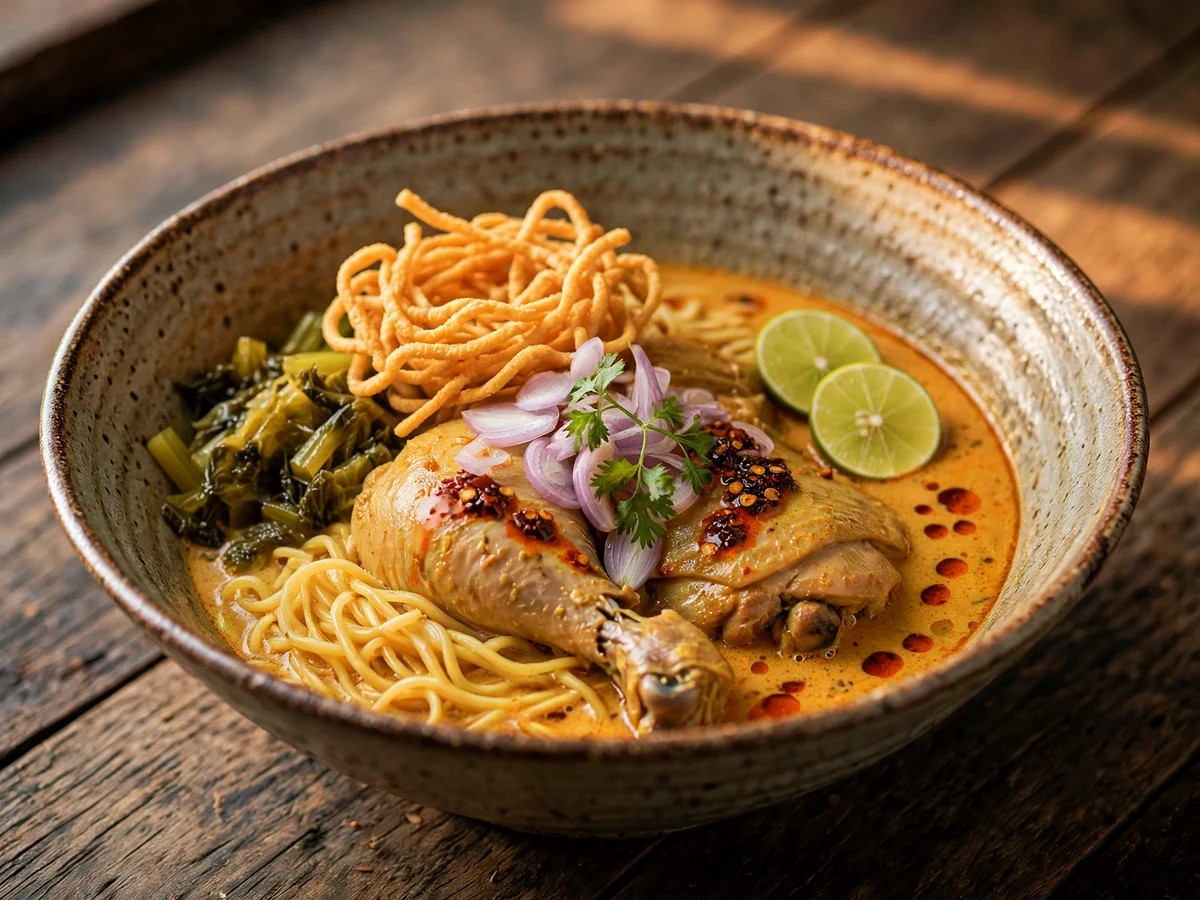
Thailand
Khao Soi
Stay in the same food culture and notice how balance a sweet-sour-salty sauce appears in another dish.
Shared thread · Balance a sweet-sour-salty sauce · shallots · fish sauce
Follow the method or pantry
02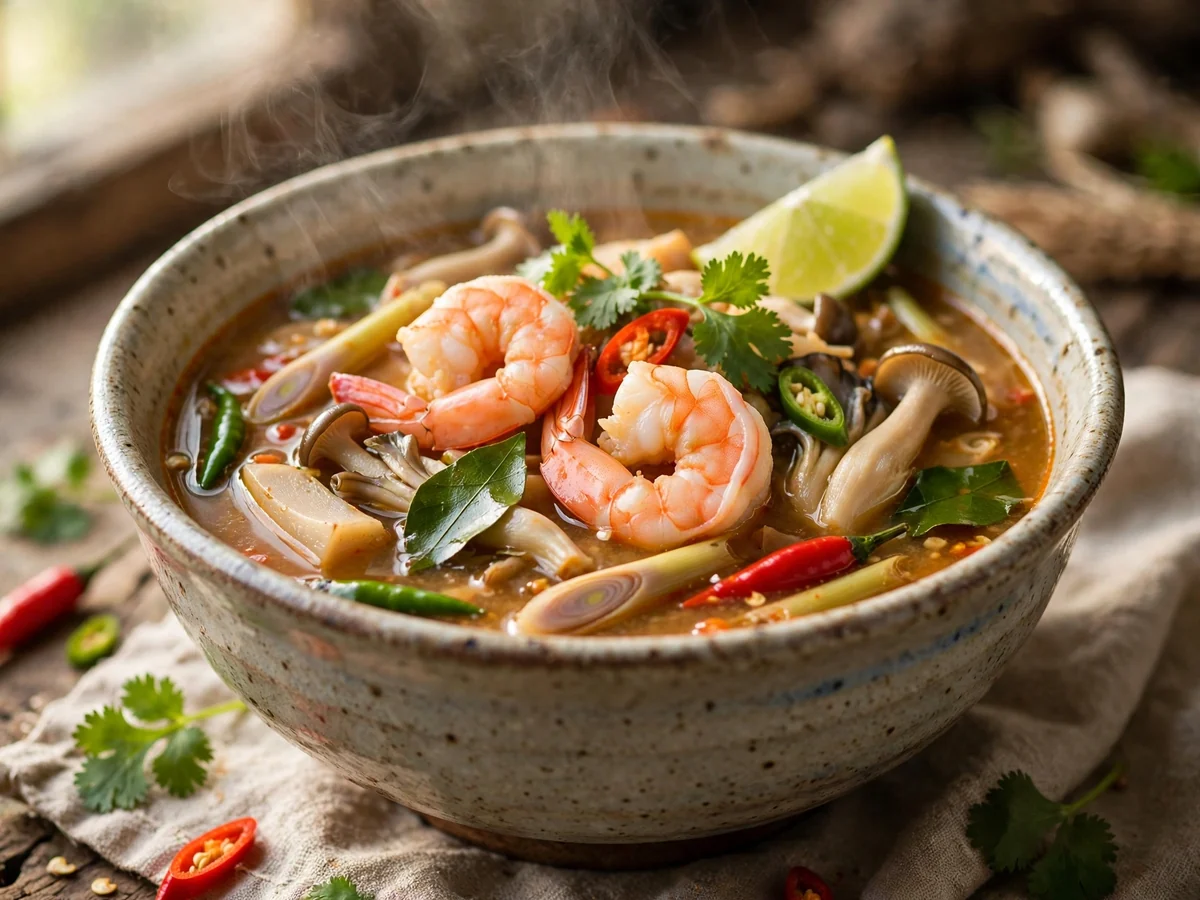
Thailand
Tom Yum Kung
Follow the cooking method: both dishes connect through balance a sweet-sour-salty sauce.
Shared thread · Balance a sweet-sour-salty sauce · raw prawns · shallots
Cross a culinary border
03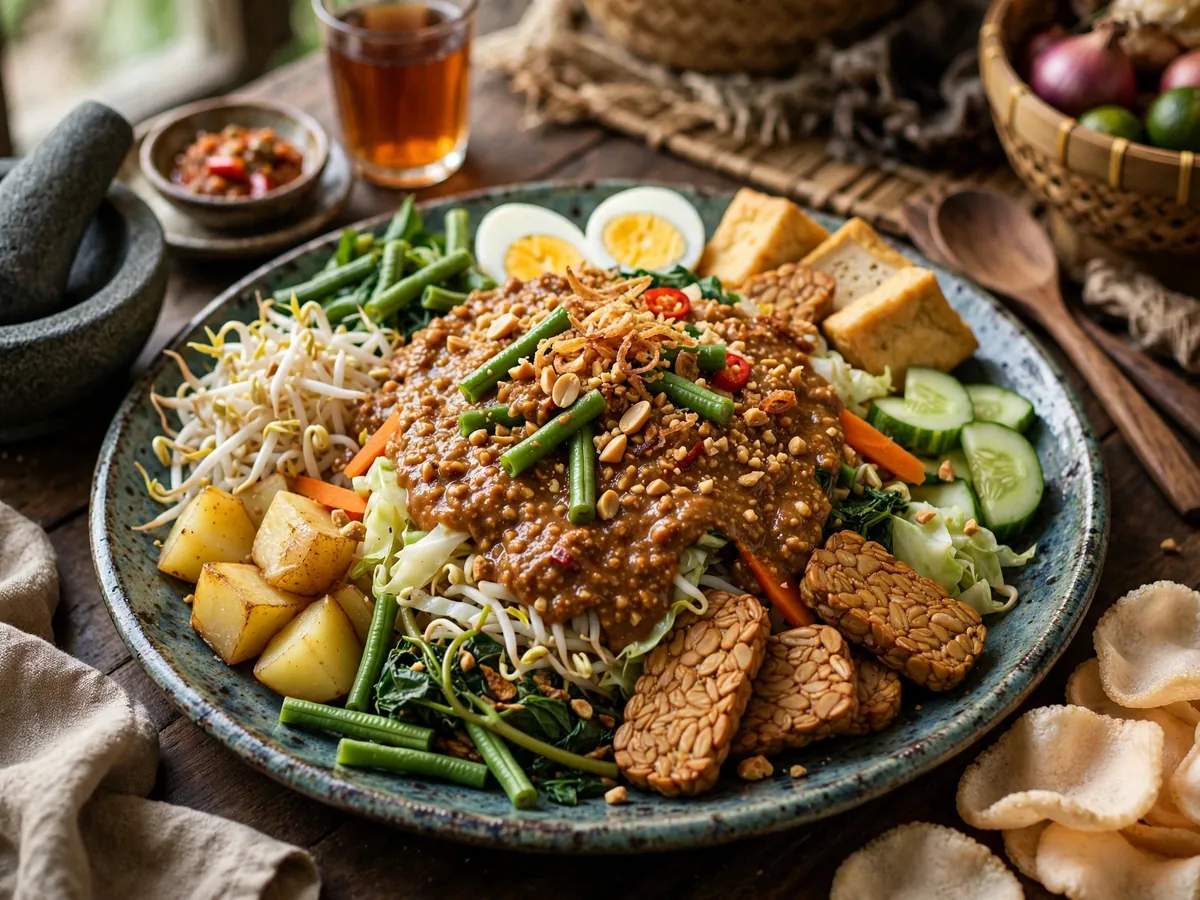
Indonesia
Gado-Gado
Cross borders while keeping balance a sweet-sour-salty sauce as the common thread.
Shared thread · Balance a sweet-sour-salty sauce · shallots · egg
Go one layer deeper
One small detail can open an entirely different part of food.
Continue in Ember & Equator