
Greece · breakfast · lunch · snack
Spanakopita
Greece through one enduring dish.
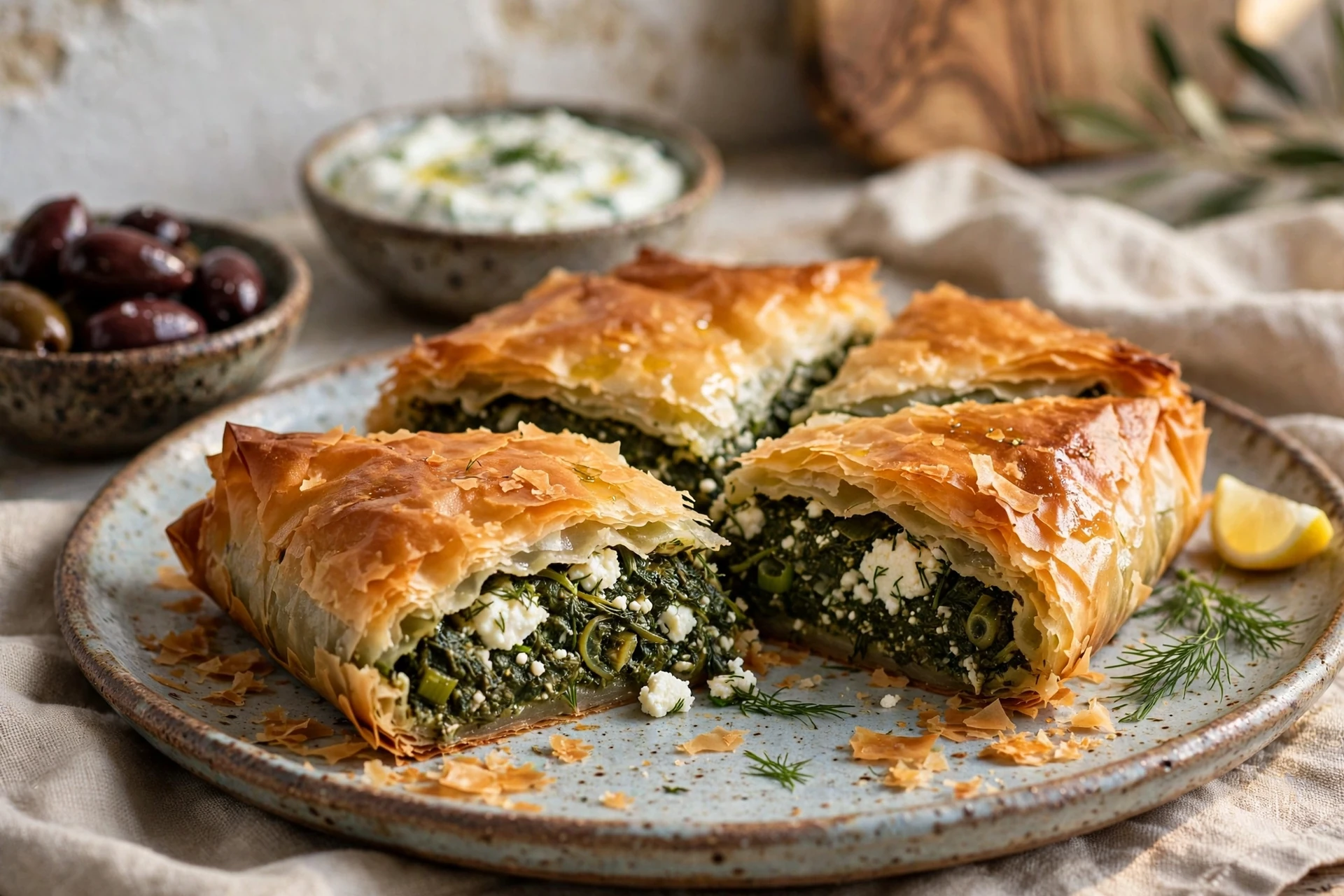
Spanakopita is a Greek savoury spinach-and-feta pie enclosed in crisp phyllo pastry. The filling should stay moist but never wet, while the phyllo should remain in distinct lightly oiled layers that bake shatteringly crisp around the herb-rich greens and feta.
- Total
- 80 min
- Difficulty
- Medium
- Serves
- 8
- Steps
- 6
The dish
Place first. Then the plate.
Greek savoury pies have deep regional roots and vary widely in pastry, greens, herbs and cheese. Spanakopita is one of the best-known spinach pies; this Ember & Equator version uses commercial phyllo for accessibility while preserving the moisture-control and layered-pastry techniques that determine success.
Explore GreeceAt a glance
Origin
Greece
Region
Mainland Greece, with regional variations
Method
baked
Meal
breakfast · lunch · snack
Guided steps
6
Dish
Spanakopita
Cuisine
Greek cuisine
Food type
Savoury pie · Breakfast · Lunch
Technique
Squeeze cooked greens · Layer · Bake filled pastry
Cook the recipe
In the kitchen
Start with the ingredients, then follow the Method in order. Open cooking tips only when you need extra help; the story and references can wait until you are ready.
- Total
- 80 min
- Serves
- 8
- Level
- Medium
- Visual cues
- 6
Ingredients
Serves 8- 700 gbaby spinachwashed and dried
- 1 mediumyellow onionfinely sliced
- 6 wholespring onionsthinly sliced
- 30 gfresh dillchopped; reduce to taste
- 25 gfresh parsleychopped
- 250 gfeta cheesecrumbled; taste before adding extra salt
- 2 largeeggslightly beaten
- 0.5 tspblack pepperfreshly ground
- 12 sheetsfilo pastrythawed completely in the refrigerator if frozen
- 100 mlextra virgin olive oilfor the filling and brushing the phyllo
Everything ready? Continue straight into the cooking steps.
Start methodMethod
6 steps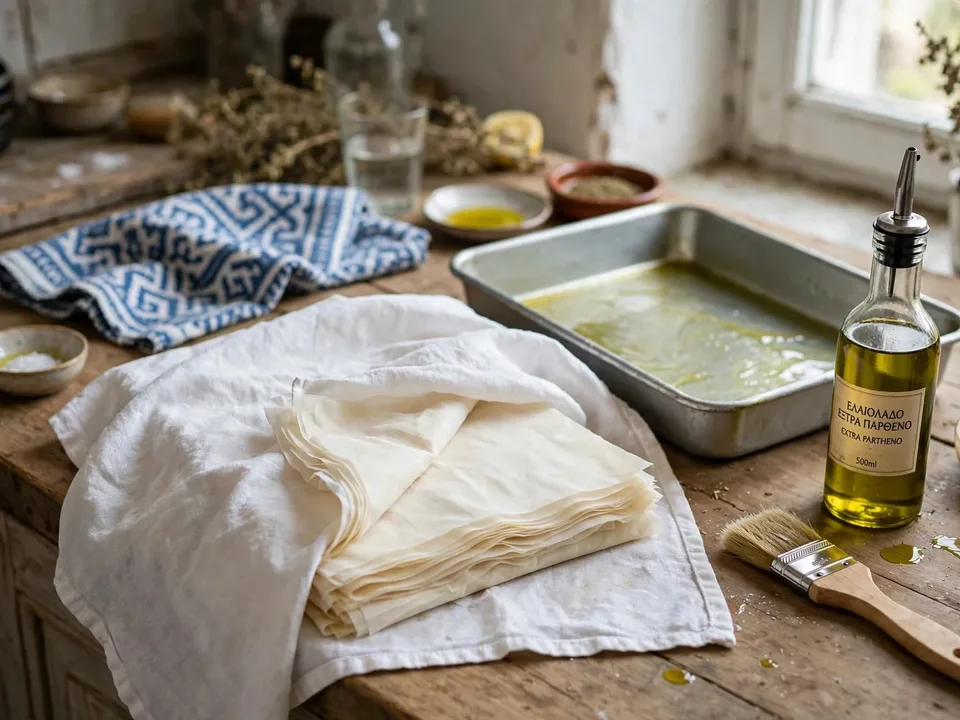 Step 01
Prepare the phyllo, pan and oven before the filling is ready
10 min
If using frozen phyllo, thaw it completely in the refrigerator according to the packet—ideally overnight—before opening.
If using frozen phyllo, thaw it completely in the refrigerator according to the packet—ideally overnight—before opening. Heat the oven to 190°C / 375°F and lightly oil a roughly 23 x 33 cm baking dish. Keep the unopened or unrolled phyllo protected from air until assembly; once opened, cover the stack with a barely damp clean towel while you work.
Look for
The sheets should be fully flexible with no icy or brittle patches, and the oven and pan should be ready before the pastry is exposed.
Kitchen note
Phyllo cracks when partly frozen and dries quickly once exposed. Set up the pan, oil, brush and damp towel before you open the pastry so assembly can move without pauses. Keep unused phyllo covered with plastic or parchment plus a barely damp towel; a wet towel touching the pastry can make sheets gummy, while uncovered sheets become brittle within minutes.
 Step 02
Soften the onion and wilt the spinach briefly
8 min
Warm 1 tablespoon olive oil in a wide pan over medium heat.
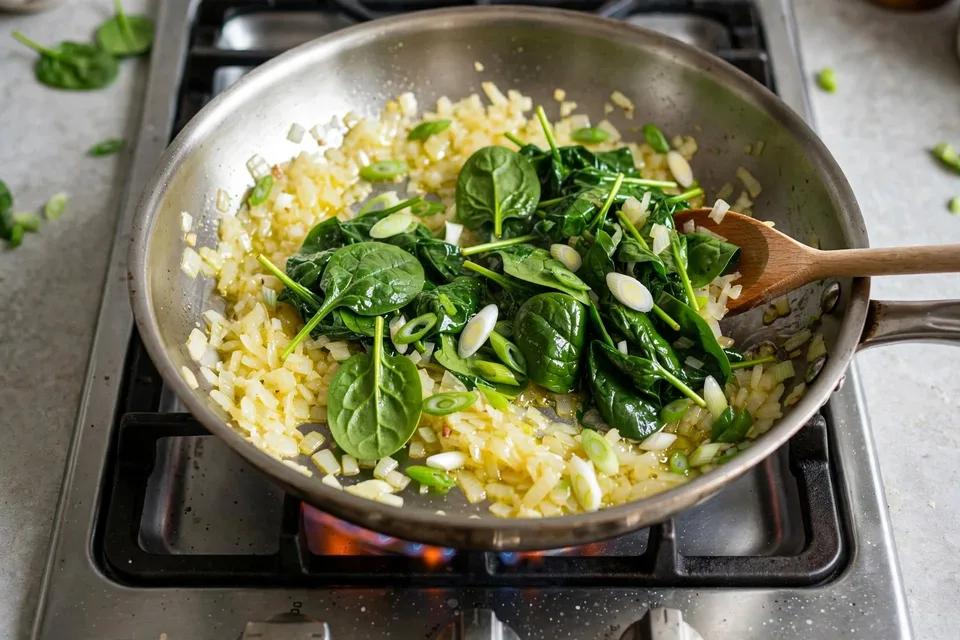
Warm 1 tablespoon olive oil in a wide pan over medium heat. Cook the yellow onion for 4–5 minutes until soft and translucent, then add the spring onions for 1 minute. Add the spinach in batches and turn only until each batch collapses and turns glossy bright green. Remove from the heat and spread out to cool rather than continuing to steam it in a deep pile.
Look for
Onion should be soft without dark browning; spinach should be just collapsed and bright green, not cooked into a dark wet mass.
Kitchen note
Use a wide pan and work in batches. Crowding a mountain of wet spinach traps steam and creates more liquid for you to fight later.
 Step 03
Cool, squeeze and chop the greens very dry
6 min
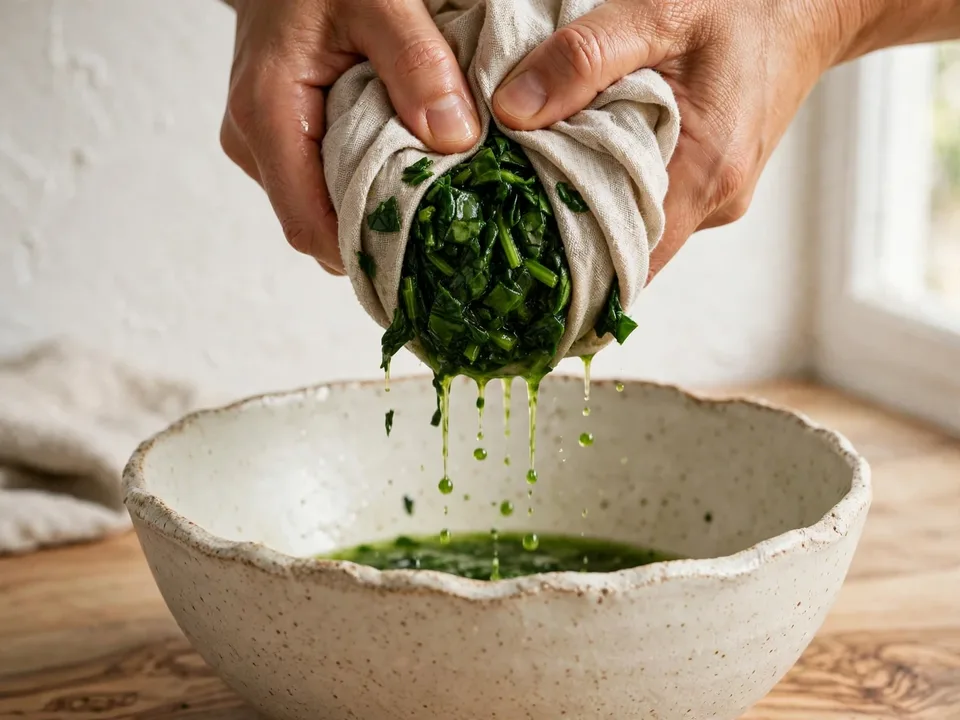
Once the spinach mixture is cool enough to handle, gather it in a clean towel and squeeze firmly until no more obvious liquid runs out.
Once the spinach mixture is cool enough to handle, gather it in a clean towel and squeeze firmly until no more obvious liquid runs out. Transfer to a board and chop roughly so long spinach strands do not drag through the filling when the pie is cut.
Look for
The greens should feel light and damp rather than wet; when squeezed in your hand they should not release droplets.
Kitchen note
This is the main crispness safeguard. If you are uncertain whether the spinach is dry enough, squeeze again—excess water steams the phyllo from inside.
 Step 04
Mix and balance the spinach-feta filling
4 min
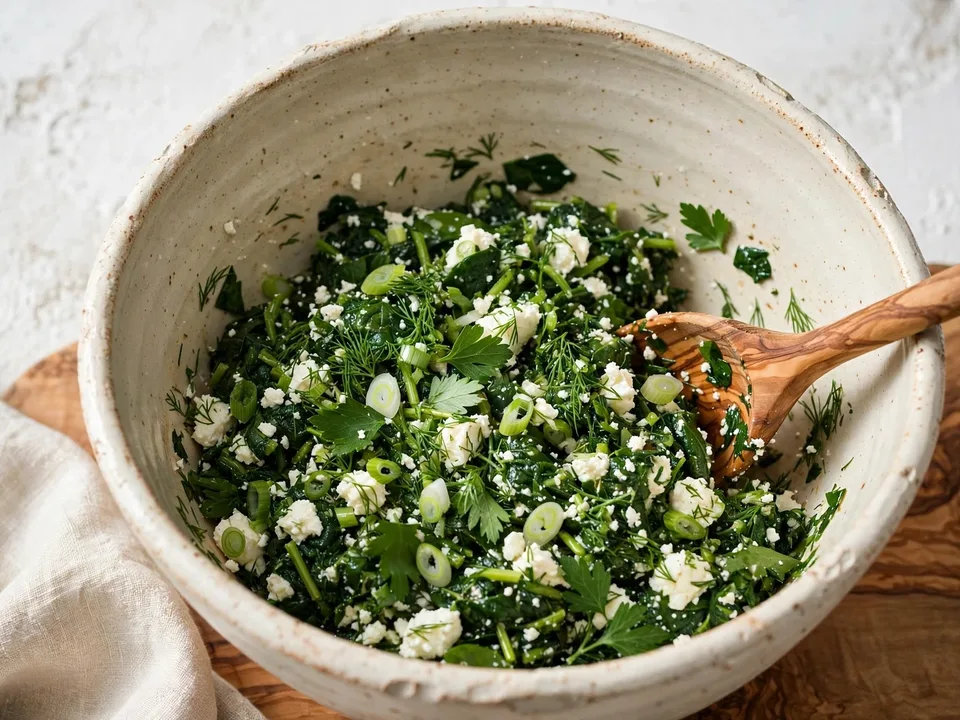
Combine the dry chopped greens with dill, parsley, crumbled feta, beaten eggs and black pepper.
Combine the dry chopped greens with dill, parsley, crumbled feta, beaten eggs and black pepper. Fold gently so feta pieces remain visible. Taste a tiny portion of the spinach-feta mixture before the raw egg goes in if you need to judge salt; feta is often salty enough that no additional salt is required. The finished filling should be cohesive but not wet.
Look for
The filling should hold together loosely with visible feta crumbs and herbs, with no liquid collecting at the bottom of the bowl.
Kitchen note
Cool the greens before adding eggs and feta. Hot spinach can partly set the egg and make feta weep, creating a denser, wetter filling.
 Step 05
Layer the phyllo, fill the pie and close the top
12 min
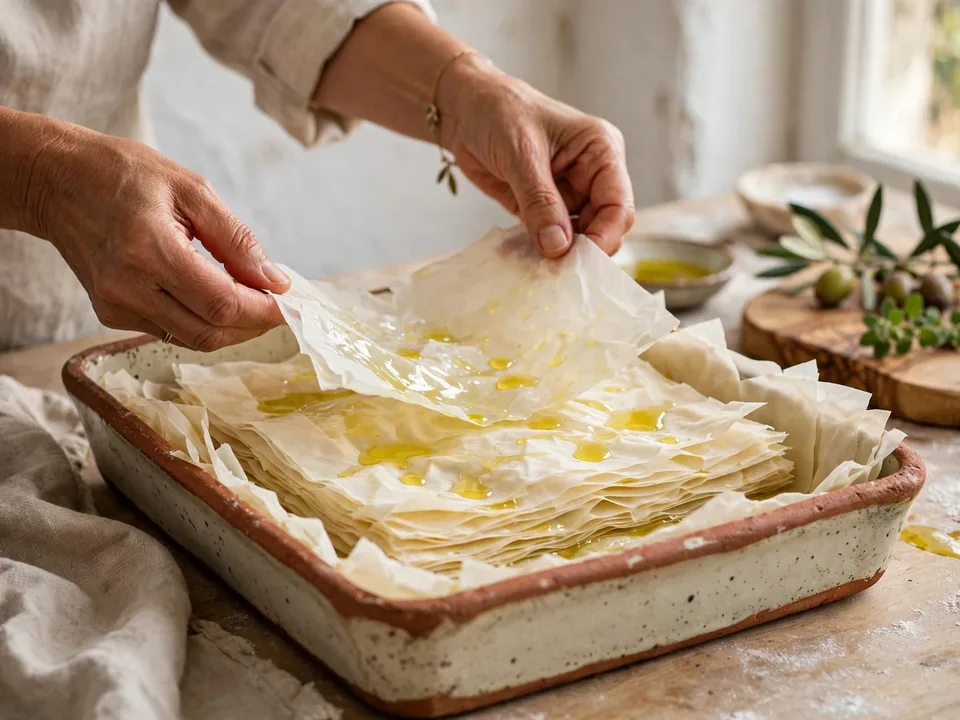
Lay one phyllo sheet in the oiled dish, letting any excess overhang, and brush or dab lightly with olive oil.
Lay one phyllo sheet in the oiled dish, letting any excess overhang, and brush or dab lightly with olive oil. Repeat with about half the sheets, rotating or offsetting them slightly so the base is evenly covered without compressing the layers. Spread the filling evenly to the corners. Cover with the remaining phyllo, lightly oiling between sheets. Fold or trim overhang neatly, brush the top, then score only the top layers into portions without cutting through the filling.
Look for
Distinct phyllo layers should still be visible at the edges, the filling should sit level rather than mound, and the top should look lightly glossy—not soaked.
Kitchen note
More oil is not more crispness. Use a light film between sheets; saturated phyllo fries into heavy greasy layers instead of separating into flakes. If a sheet tears, patch it with another piece and continue—the layered pie does not require perfect individual sheets. Keep the filling level and leave enough pastry at the edges to close without squeezing liquid out.
 Step 06
Bake deeply golden, then rest before cutting
45 min
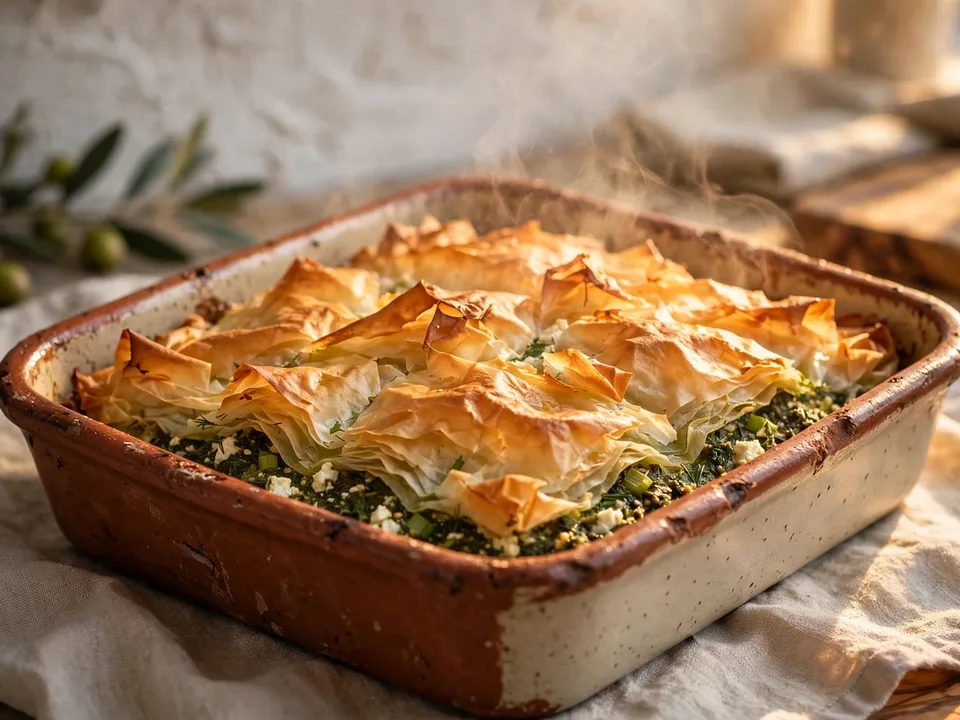
Bake on the centre rack at 190°C / 375°F for about 35–45 minutes, rotating once if your oven browns unevenly.
Bake on the centre rack at 190°C / 375°F for about 35–45 minutes, rotating once if your oven browns unevenly. The top and bottom edges should be deeply golden and crisp. Rest the pie for 10–15 minutes before following the score lines to cut portions. Serve warm or at room temperature rather than trapping steam under a tight cover.
Look for
The top should be evenly deep golden and audibly crisp, the edges should feel dry and flaky, and no wet filling should bubble through the score lines.
Kitchen note
Colour is a better endpoint than the clock. Pale phyllo is usually still soft underneath; if the top colours too fast, move the pan lower or shield loosely rather than pulling the pie while the base is underbaked.
After cooking
Explore the dish beyond the method.
Story, place and references are here for discovery, so they stay out of the way while you cook.
Culture & tradition
The story behind the dish
Origins, evolution and everyday life—read together as part of the recipe's culinary record.
Origins
Spinach and other greens pies belong to Greece’s broad regional pita tradition, especially the mainland tradition of making seasonal greens, herbs and dairy into portable savoury pies.
How it evolved
Households vary the greens, herbs, feta proportion and pastry. Homemade or thicker village-style phyllo is traditional in many settings, while commercial thin phyllo is now a common home-cook adaptation.
Its place today
Spanakopita is one of the most recognisable Greek savoury pies and is served as a snack, appetiser, side or light meal.
Visual archive · plate 01
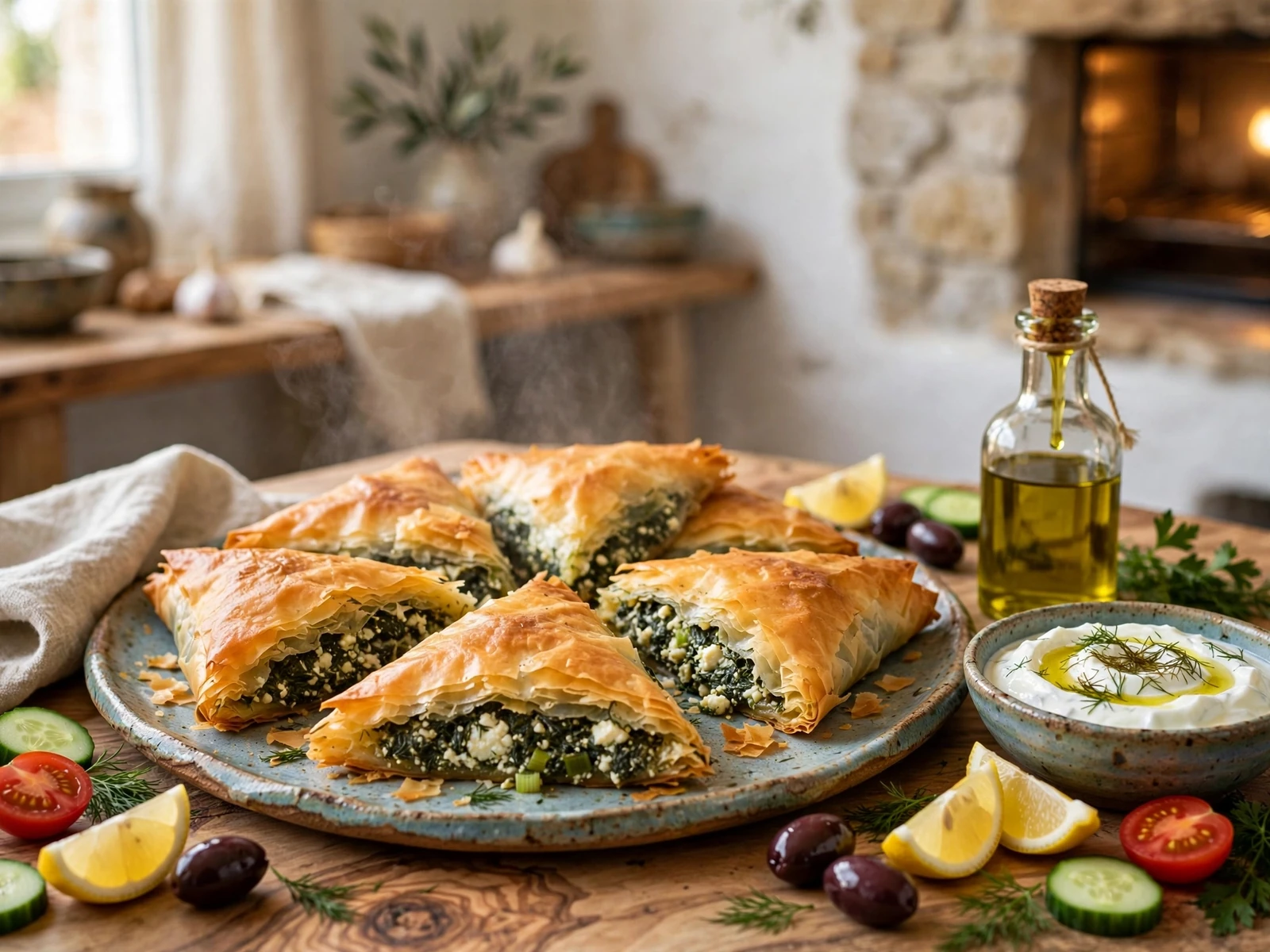
Spanakopita
An editorial view of the finished dish, kept compact so the story continues without an oversized image break.
Primary region
Mainland Greece, with regional variations
Country
Greece
Regional influence
Seasonal wild and cultivated greens, sheep- and goat-milk cheeses and grain-based pastry reflect the agricultural mix of many mainland Greek regions.
Related food systems
- Greek savoury-pie traditions
- Seasonal greens cookery
- Mediterranean dairy and grain foodways
Culinary record
- Origin
- Greece
- Era
- Traditional Greek savoury-pie foodway
- Sub-region
- Southern Europe — Eastern Mediterranean
- Climate
- Mediterranean
- Cooking methods
- baked
- Trade-route influence
- Aegean maritime trade · Eastern Mediterranean exchange · Ionian routes
Traditional & modern
Regional greens and cheeses vary; commercial filo is now common in home versions.
Regional adaptations
- Regional wild-greens and cheese variations
Sources & further reading
Follow the reference trail.
Ember & Equator links outward when an institution or primary reference helps support the culinary record.
- 01The Athenian Odyssey: History, Culture, and CuisineExternal ↗
Visit Greece · government
Supports: spanakopita identity · spinach and feta · phyllo · Greek culinary context
Ember & Equator source review · 2026-09-17
- 02Local flavours of the Greek cuisineExternal ↗
Visit Greece · government
Supports: Greek regional pie tradition · phyllo variation · greens and cheese fillings
Ember & Equator source review · 2026-09-17
- 03Spanakopita recipe with homemade phyllo (Authentic Greek spinach pie)External ↗
My Greek Dish · specialist publication
Supports: spinach-feta filling · onion, spring onion, dill and egg · phyllo · golden crisp baking
Ember & Equator source review · 2026-09-17
- 04Easy Greek Spinach pie for Beginners (Spanakopita)External ↗
My Greek Dish · specialist publication
Supports: commercial phyllo handling · onion and spinach cooking · layering · scoring · baking and resting
Ember & Equator source review · 2026-09-17
Ingredient guides
Learn about the ingredients behind the dish.
These are reference guides, not a second ingredient list. Follow an ingredient when you want to understand its role, use and wider culinary context.
Ingredient
baby spinach
Understand what it contributes, how to use it, and the dishes that reveal it best.
Ingredient
yellow onion
Understand what it contributes, how to use it, and the dishes that reveal it best.
Ingredient
spring onions
Understand what it contributes, how to use it, and the dishes that reveal it best.
Ingredient
fresh dill
Understand what it contributes, how to use it, and the dishes that reveal it best.
Ingredient
parsley
Understand what it contributes, how to use it, and the dishes that reveal it best.
Ingredient
feta cheese
Understand what it contributes, how to use it, and the dishes that reveal it best.
Keep wandering
Where will this dish take you next?
Stay with the place, follow an ingredient or technique, or cross into another food culture. Each path begins with something already present in this dish.
Stay with the place
01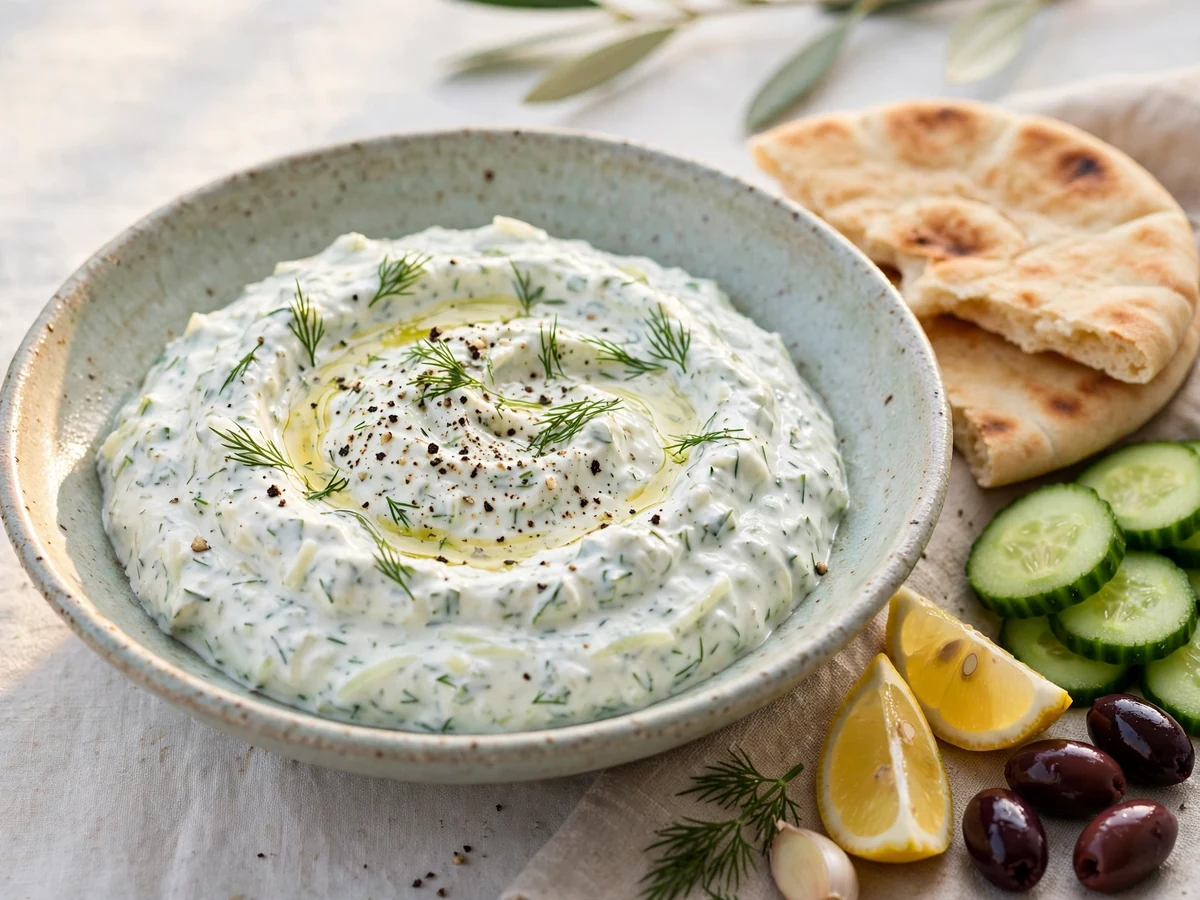
Greece
Tzatziki
Stay in the same food culture and notice how fold appears in another dish.
Shared thread · Fold · fresh dill · black pepper
Follow the method or pantry
02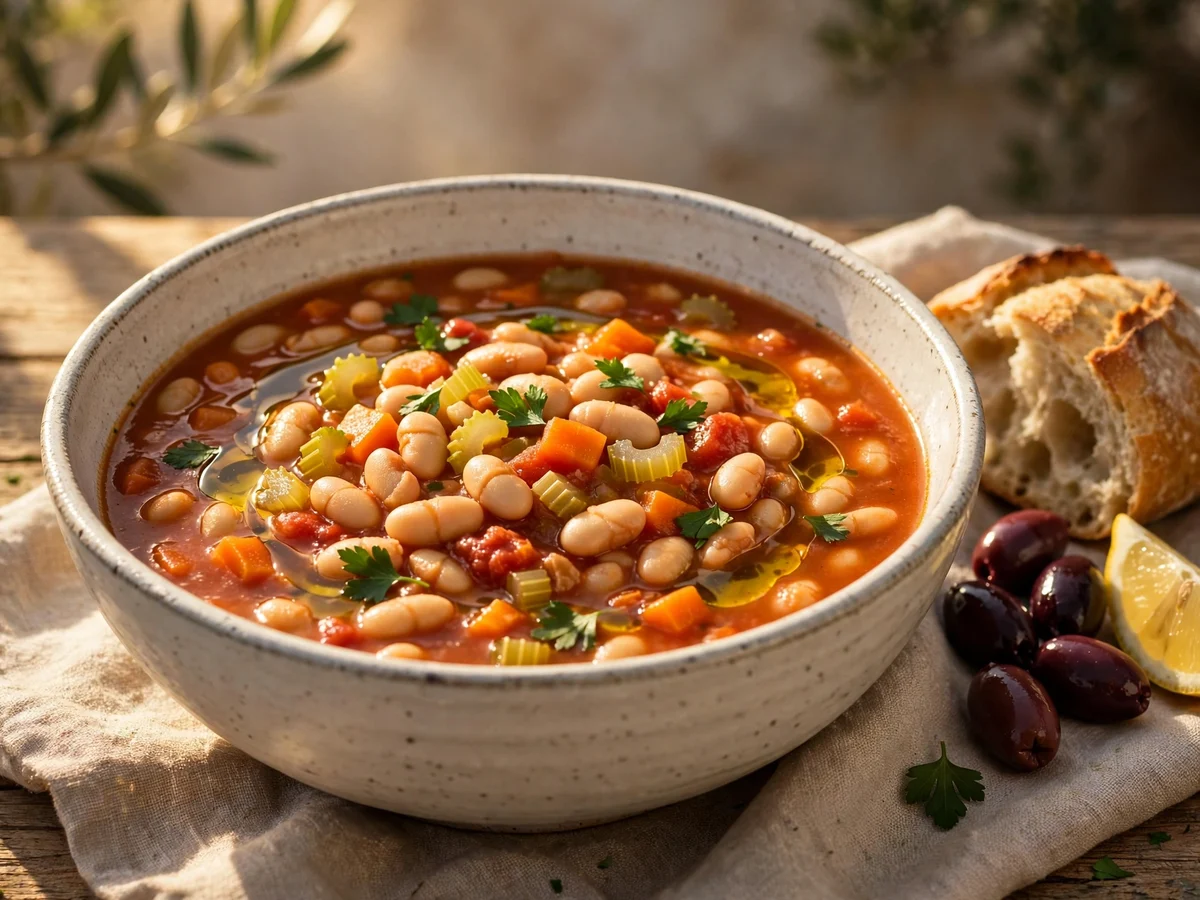
Greece
Fasolada
Follow the pantry: both dishes connect through yellow onion.
Shared thread · yellow onion · black pepper · extra virgin olive oil
Cross a culinary border
03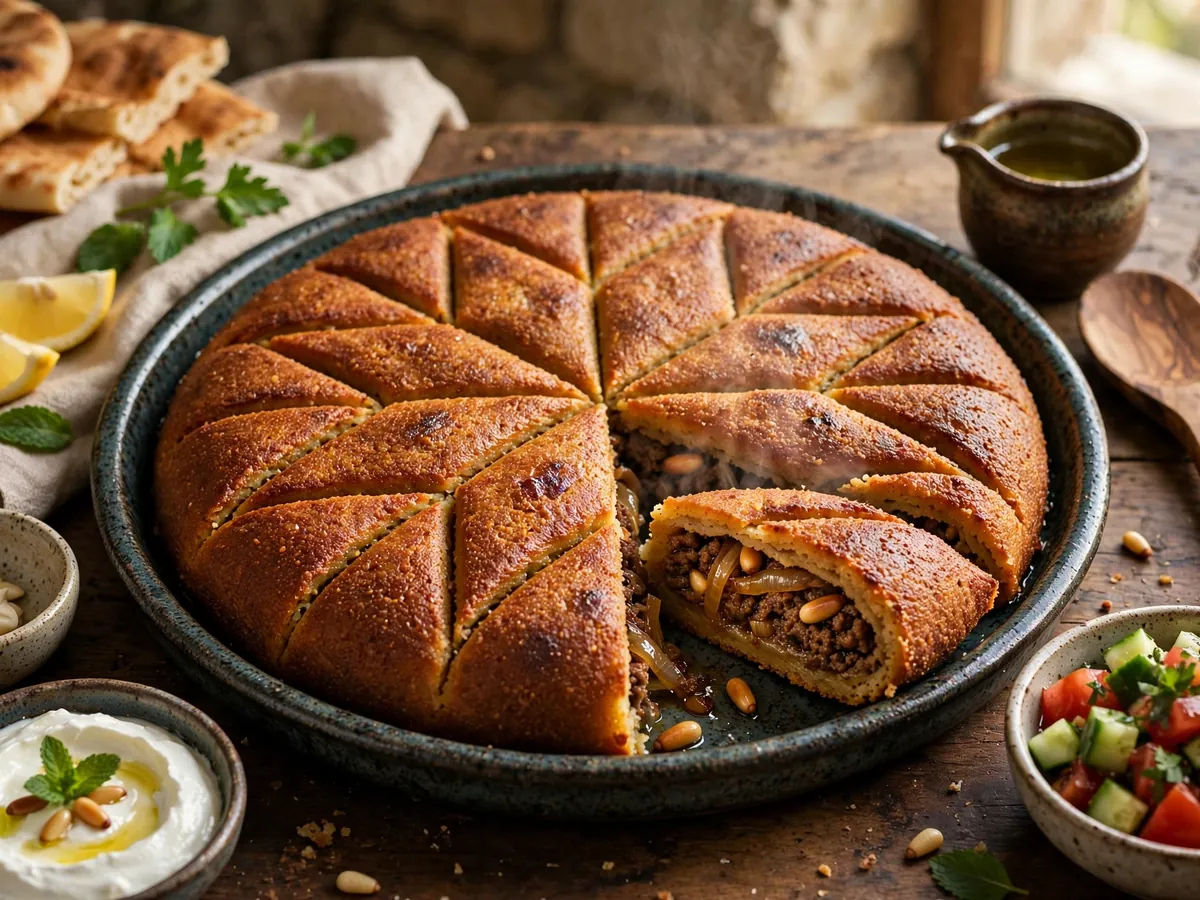
Lebanon
Kibbeh Bil Sanieh
Cross borders while keeping layer as the common thread.
Shared thread · Layer · Sauté · yellow onion
Go one layer deeper
One small detail can open an entirely different part of food.
Continue in Ember & Equator