
Japan · lunch · dinner · comfort-food
Katsudon
Japan through one enduring dish.
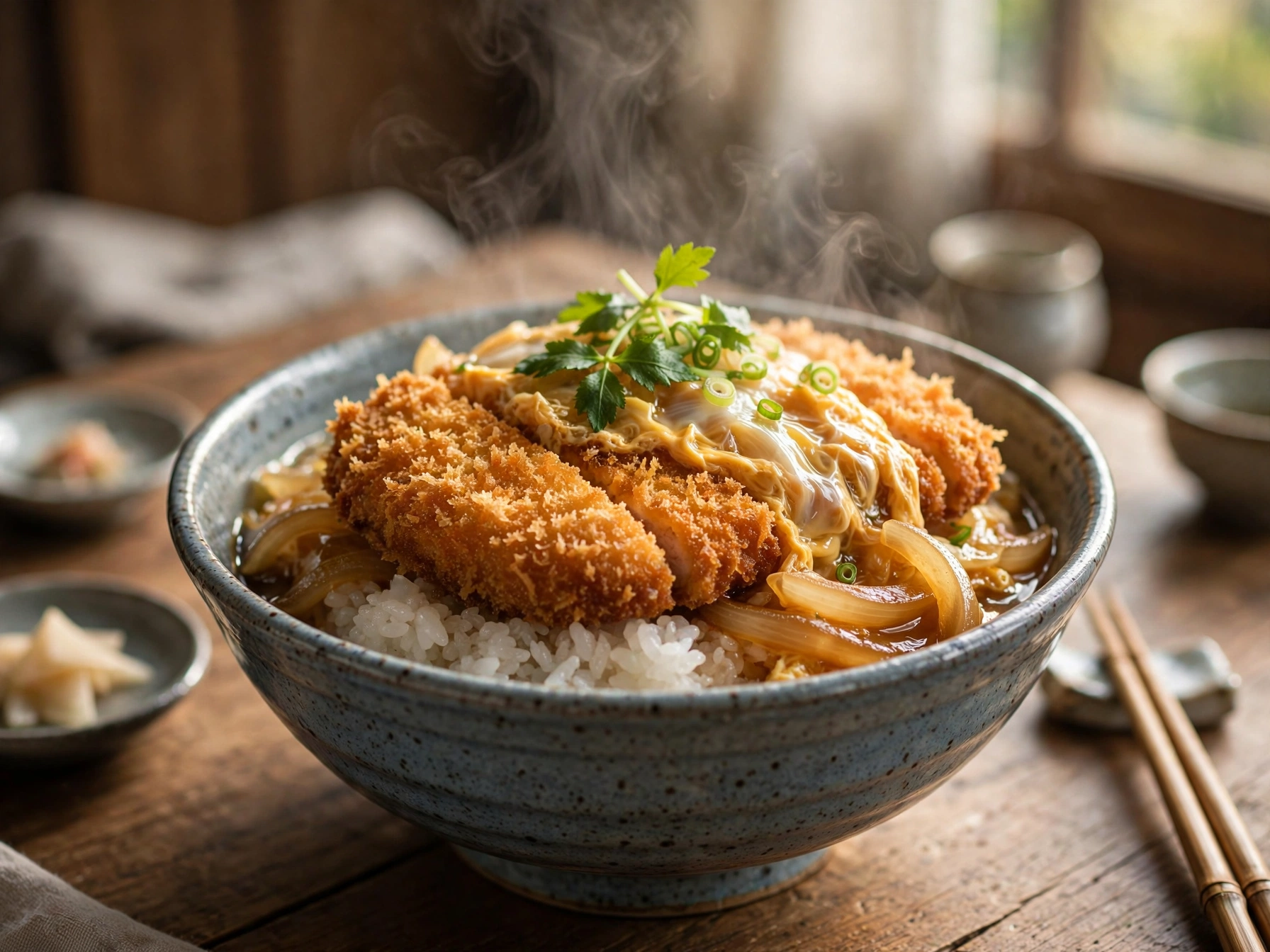
Katsudon is a Japanese donburi of crisp tonkatsu briefly simmered with tender onion in a savory-sweet dashi sauce, finished with softly set egg and served over steaming Japanese short-grain rice. The defining balance is juicy pork, crisp panko edges, sauce-soaked undersides, soft egg and fluffy rice in the same bite.
- Total
- 50 min
- Difficulty
- Medium
- Serves
- 2
- Steps
- 12
The dish
Place first. Then the plate.
MAFF documents katsudon as a regional food in Yamanashi, where the name commonly means a pork cutlet over rice and shredded cabbage with sauce. Ember & Equator presents the widely recognized egg-bound donburi style while clearly acknowledging that “katsudon” changes by region.
Explore JapanAt a glance
Origin
Japan
Region
Japan, with documented regional forms including Yamanashi
Meal
lunch · dinner · comfort-food
Guided steps
12
Dish
Katsudon
Cuisine
Japanese cuisine
Food type
Lunch · Dinner · Comfort food
Technique
Fry · Simmer
Cook the recipe
In the kitchen
Start with the ingredients, then follow the Method in order. Open cooking tips only when you need extra help; the story and references can wait until you are ready.
- Total
- 50 min
- Serves
- 2
- Level
- Medium
- Visual cues
- 12
Ingredients
Serves 2- 2 piecespork loin chopsboneless, about 150–180 g each; moderately thick
- 1/2 tspfine saltor to taste, for seasoning the pork
- 1/4 tspblack pepperfreshly ground, for seasoning the pork
- 2–3 tbspplain flourfor a light dredging coat
- 4 largeeggs1 for breading and 3 for the donburi topping
- 3/4 cuppanko breadcrumbscoarse Japanese panko; nama panko if available
- 500 mlneutral oilor enough for frying the cutlets with good depth
- 120 mldashi stock1/2 cup
- 2 tbspsoy sauceJapanese soy sauce
- 2 tbspmirinhon mirin if available
- 1 tbspsakefor the katsudon sauce
- 1–2 tspsugaradjust to taste
- 1 mediumonionthinly sliced
- 2 bowlscooked short-grain ricefreshly steamed Japanese short-grain rice
Optional
- 2 tbspmitsuba or spring onionsroughly chopped or thinly sliced, for garnish
- 1 pinchshichimi togarashioptional, for serving
Everything ready? Continue straight into the cooking steps.
Start methodMethod
12 stepsMethod at a glance
 Step 01
Prepare the pork
5 min
Trim away only any thick or hard exterior fat, leaving a little for flavour.
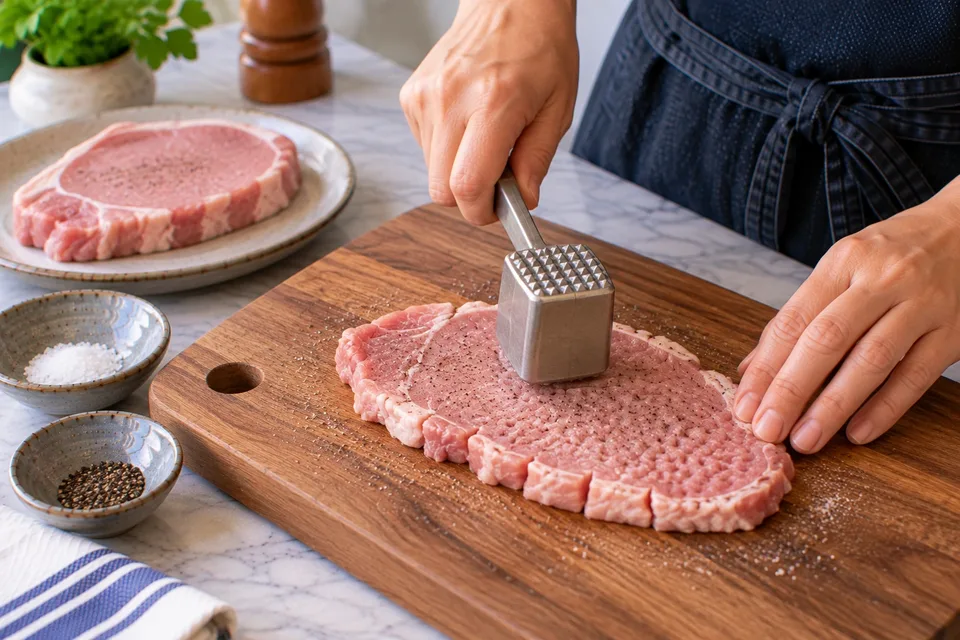
Trim away only any thick or hard exterior fat, leaving a little for flavour. Make a few small cuts through the connective tissue around the edges so the chops do not curl during frying. Lightly pound each pork loin chop to an even thickness, then gently reshape it. Season both sides with salt and freshly ground black pepper.
Look for
The chops should be evenly thick from centre to edge, still substantial rather than thin, with no tight connective-tissue band pulling the meat into a curve.
Kitchen note
Do not pound the pork paper-thin. Katsudon works best when the cutlet stays substantial enough to remain juicy after frying and the brief simmer in sauce.
 Step 02
Bread the pork
5 min
Set up three shallow dishes in order: flour, 1 beaten egg and panko.
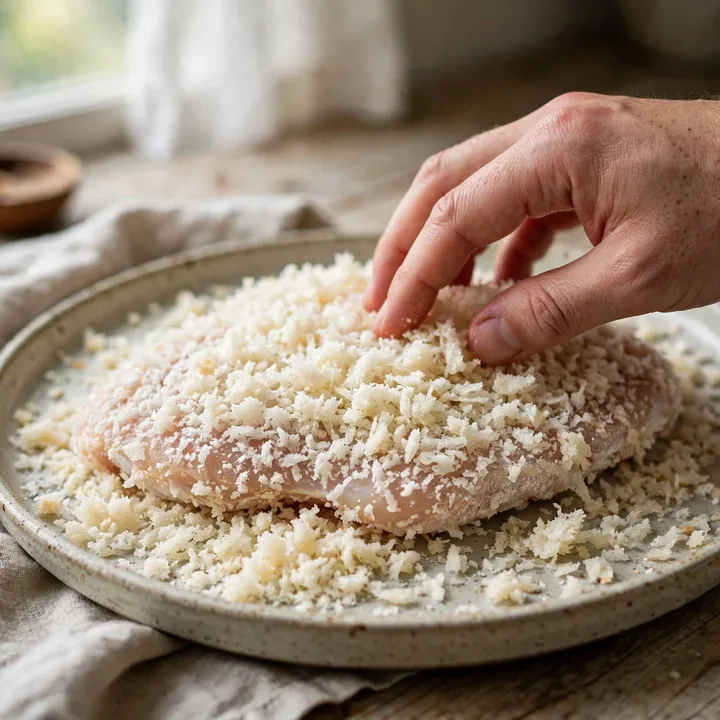
Set up three shallow dishes in order: flour, 1 beaten egg and panko. Coat each chop lightly in flour and shake off the excess. Dip fully in the beaten egg, allowing any heavy drips to fall away, then press both sides firmly into the panko so coarse crumbs adhere right to the edges.
Look for
The pork should be evenly covered with a light, fluffy panko layer, with no wet egg patches, bare meat or thick pasty flour deposits.
Kitchen note
Keep the panko coarse. Large airy crumbs give tonkatsu its characteristic crunch; crushing them too fine produces a denser crust.
 Step 03
Rest the breaded cutlets
5 min
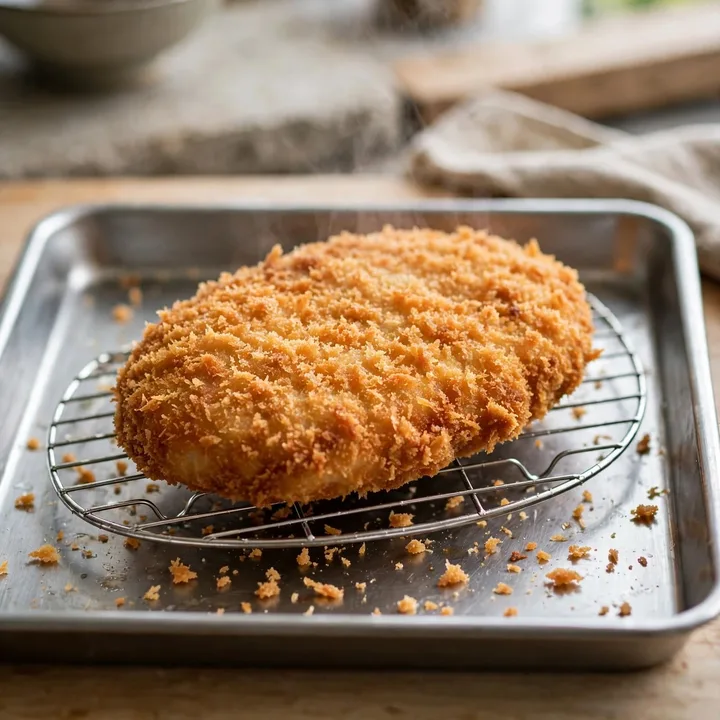
Place the breaded pork on a wire rack or clean tray and let it rest for 3–5 minutes before frying.
Place the breaded pork on a wire rack or clean tray and let it rest for 3–5 minutes before frying. Use this short pause to finish heating the oil and prepare the remaining ingredients for the donburi.
Look for
The panko should look dry and firmly attached rather than sliding or shedding when the cutlet is lifted.
Kitchen note
A brief rest helps the breading hydrate and adhere to the pork, reducing the chance that the crust separates when the cutlet enters the oil.
 Step 04
Fry the tonkatsu
8 min
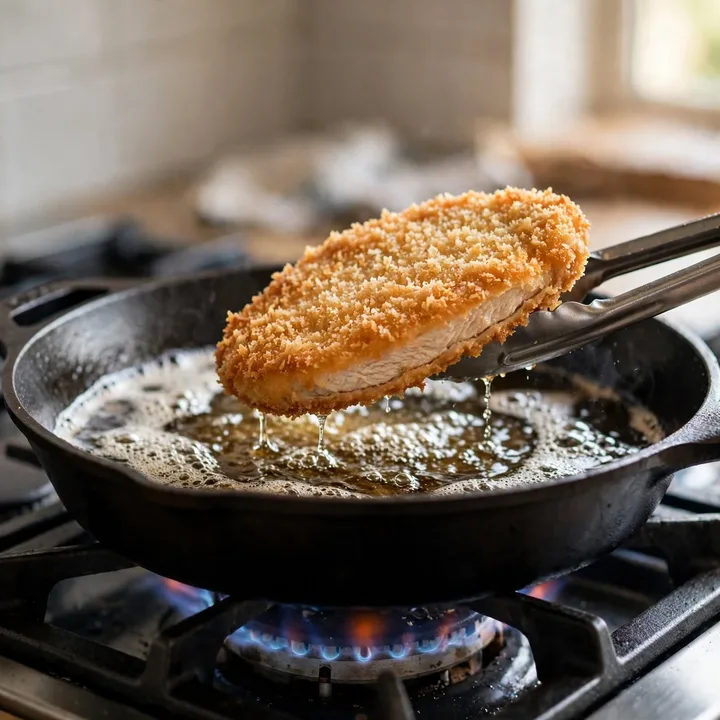
Heat neutral oil to about 170–175°C / 340–350°F.
Heat neutral oil to about 170–175°C / 340–350°F. Carefully lower in one cutlet at a time, or fry without crowding if your pan is large enough. Cook until the panko is deeply golden and crisp and the pork is cooked through, turning once for even colour. Depending on thickness, this usually takes about 4–6 minutes total.
Look for
The oil should bubble actively but not violently, and the crust should turn evenly deep golden rather than remaining pale or browning almost immediately.
Kitchen note
Oil temperature is critical. Cool oil makes the panko greasy; excessively hot oil darkens the crumbs before the pork has cooked through.
 Step 05
Drain, rest and slice the tonkatsu
4 min
Transfer the fried cutlets to a wire rack rather than laying them directly on paper towels.
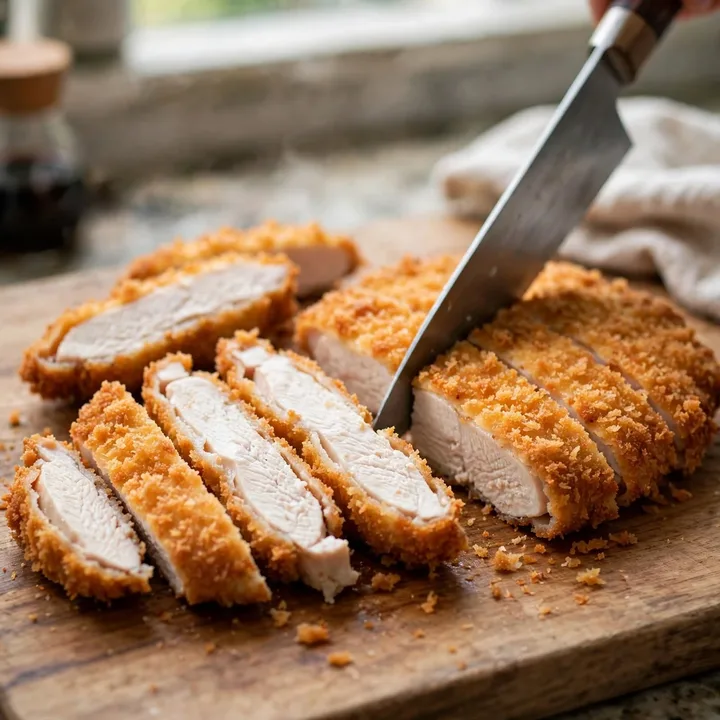
Transfer the fried cutlets to a wire rack rather than laying them directly on paper towels. Rest for 2–3 minutes so excess oil drains and the pork juices settle, then slice each cutlet crosswise into thick strips while keeping the slices arranged in the original cutlet shape.
Look for
The crust should stay crisp and attached while the pork inside looks juicy rather than dry; after slicing, keep the pieces neatly aligned for transfer.
Kitchen note
The wire rack keeps steam away from the underside and protects the crust. Slicing before the sauce stage helps the broth season the cutlet evenly and makes the finished bowl easier to eat with chopsticks.
 Step 06
Simmer the onion in dashi until nearly tender
5 min
Add the thinly sliced onion and dashi to a small donburi pan or wide skillet.
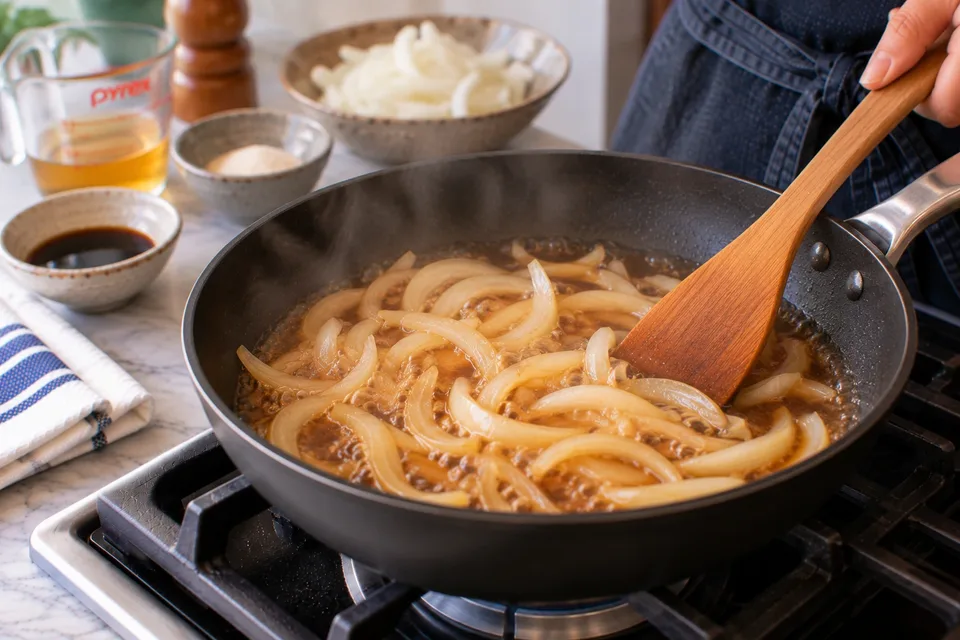
Add the thinly sliced onion and dashi to a small donburi pan or wide skillet. Cover and bring to a gentle simmer over medium heat, then cook for about 3–5 minutes until the onion is supple and almost translucent but still holds its shape.
Look for
The onion should look supple and almost translucent while the dashi remains a shallow, lightly coloured broth.
Kitchen note
Cook the onion in the dashi before adding the stronger seasonings. This softens it evenly while preserving a clean dashi foundation for the donburi broth.
 Step 07
Season the broth
2 min
Add the soy sauce, mirin, sake and 1 teaspoon sugar to the tender onion and dashi.
Add the soy sauce, mirin, sake and 1 teaspoon sugar to the tender onion and dashi. Stir gently to combine and keep the mixture at a restrained simmer. Taste before it reduces; add the remaining sugar only if you want a slightly sweeter donburi balance. Keep enough shallow broth in the pan to moisten the cutlet and softly set the egg.
Look for
The broth should turn glossy brown while remaining shallow and fluid, with tender translucent onion and no syrupy reduction.
Kitchen note
Season after the onion has softened in dashi. Keep this a shallow donburi broth, not a sticky glaze, because the liquid still needs to warm the cutlet and set the egg.
 Step 08
Add the sliced tonkatsu briefly
1 min
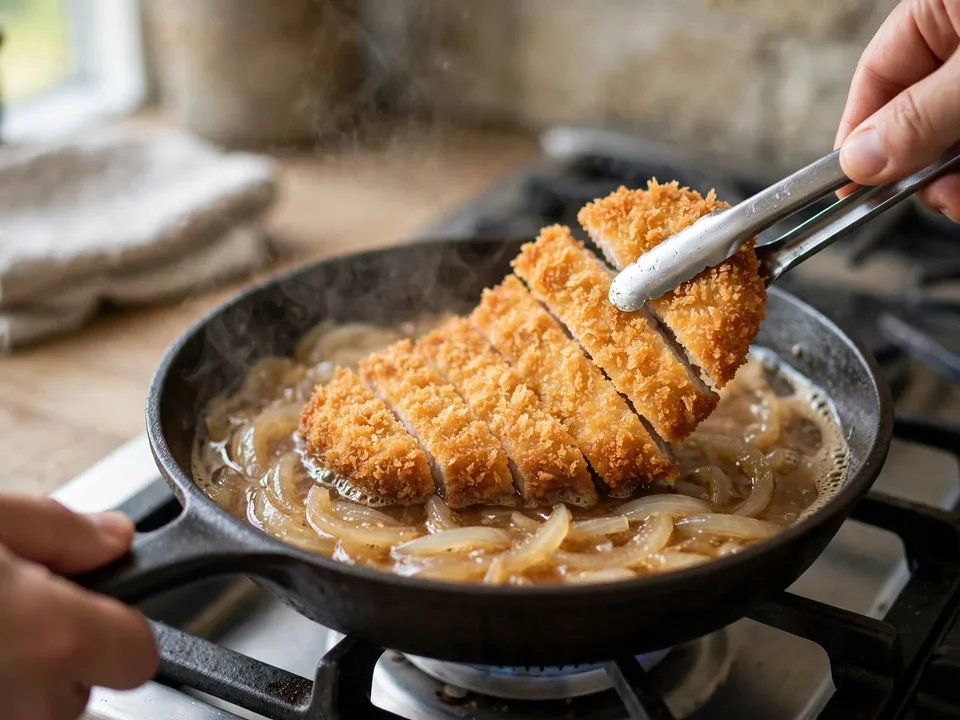
Arrange the sliced tonkatsu over the simmering onions, keeping the pieces together.
Arrange the sliced tonkatsu over the simmering onions, keeping the pieces together. Let it cook for only about 45–60 seconds so the underside absorbs some seasoned broth while the upper crust and edges remain visibly crisp.
Look for
The bottoms of the cutlet pieces should look moistened by the broth while coarse golden panko remains visible and crisp-looking on top.
Kitchen note
This is the key katsudon balance: the cutlet should be seasoned by the sauce without becoming completely soggy. Do not simmer it for several minutes.
 Step 09
Pour in the first egg
1 min
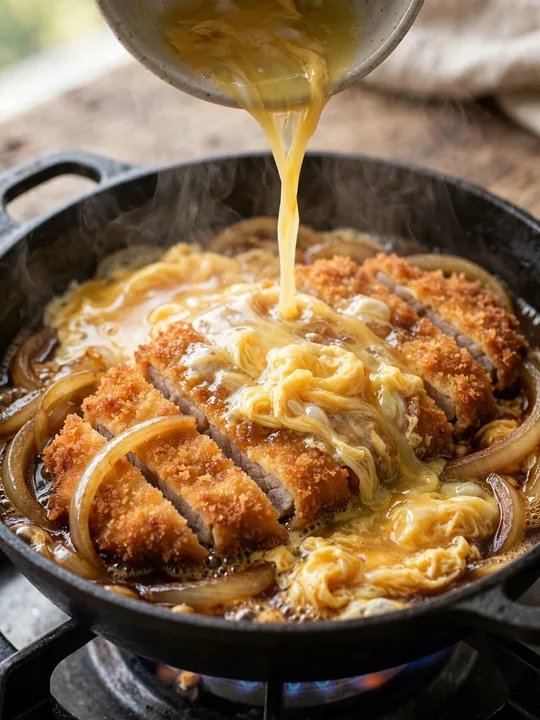
Lightly beat the 3 topping eggs just enough to break the whites and yolks without blending them completely smooth.
Lightly beat the 3 topping eggs just enough to break the whites and yolks without blending them completely smooth. Pour about two-thirds of the egg around and over the tonkatsu. Cover and cook gently for about 45–60 seconds, until this first addition is partially set into soft ribbons.
Look for
The first egg addition should begin setting around the cutlet in soft silky ribbons while some glossy liquid egg remains visible.
Kitchen note
Do not fully scramble the eggs before they go into the pan. Leaving the mixture slightly streaky creates distinct soft white and yolk textures in the finished bowl.
 Step 10
Finish with the remaining egg
1 min
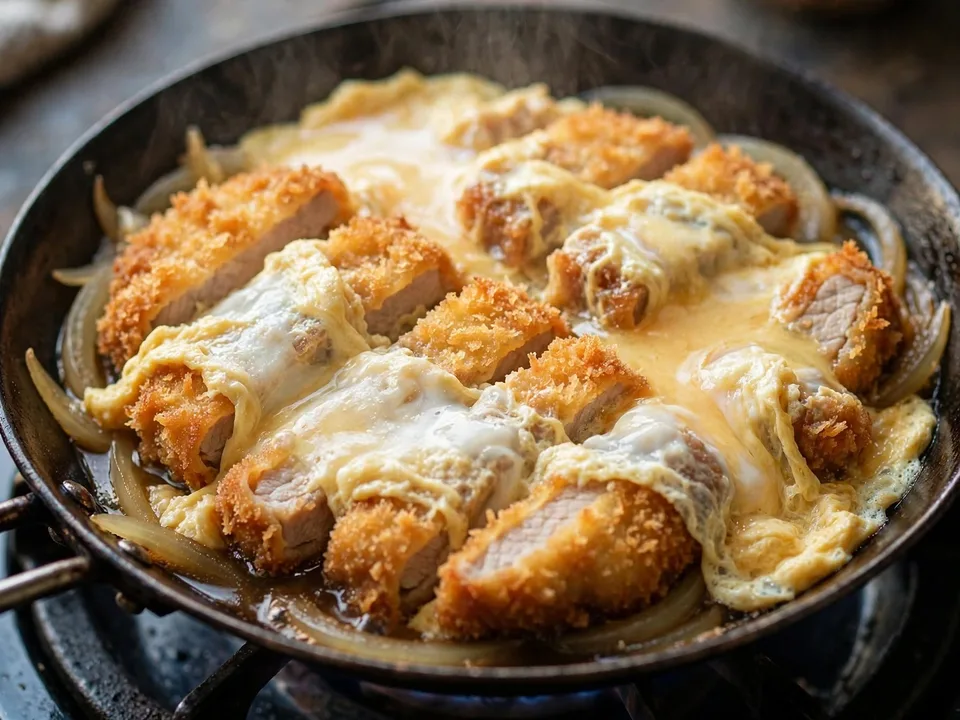
Pour the remaining egg over the pan and cook only briefly, covered or uncovered depending on how soft you prefer it.
Pour the remaining egg over the pan and cook only briefly, covered or uncovered depending on how soft you prefer it. Stop while the whites are just set and the yolk-rich portions still look moist, soft and glossy. Remove the pan from the heat immediately; residual heat will continue cooking the egg.
Look for
The egg should look softly set and custardy with visible glossy areas, not dry, rubbery or uniformly scrambled.
Kitchen note
The two-stage egg addition is the secret to a custardy katsudon. The first portion gives structure while the final portion stays softer and more delicate.
 Step 11
Slide the katsudon over hot rice
1 min
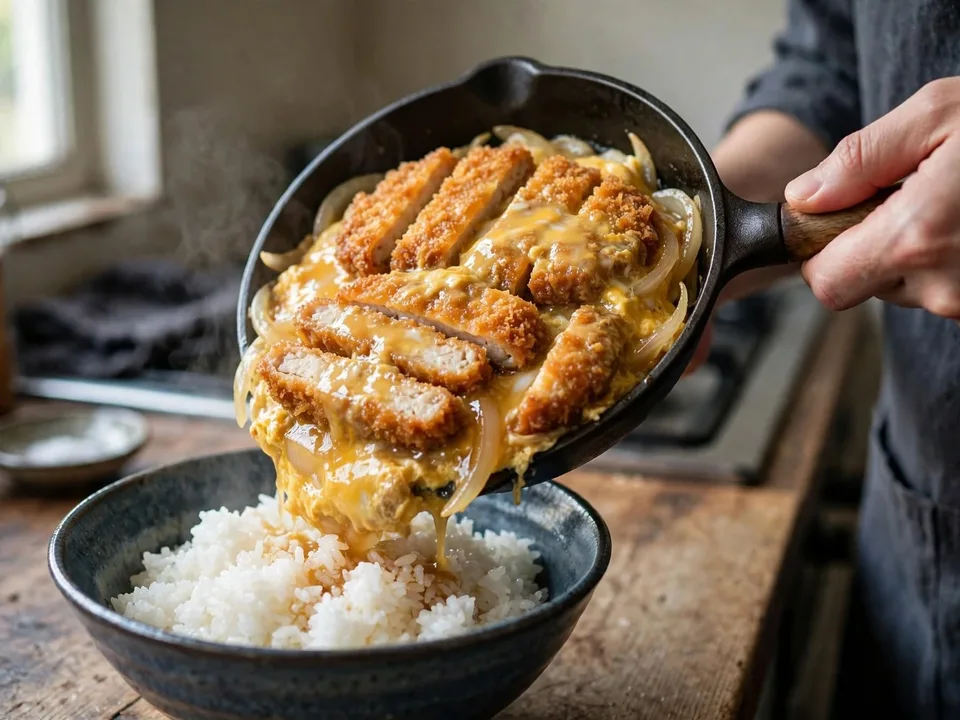
Divide freshly steamed Japanese short-grain rice between two donburi bowls.
Divide freshly steamed Japanese short-grain rice between two donburi bowls. While everything is still hot, carefully slide the entire tonkatsu, onion, egg and sauce mixture from the pan over the rice, keeping the cutlet arrangement intact. Spoon over only the broth that remains naturally in the pan rather than flooding the bowl.
Look for
The rice should remain fluffy and distinct under the topping, with enough sauce to season the grains but no deep pool collecting in the bowl.
Kitchen note
Have the rice portioned before the egg is finished. Katsudon waits for no one: delaying assembly makes the egg firmer and the crust progressively softer.
 Step 12
Garnish and serve immediately
1 min
Finish each bowl with mitsuba or sliced spring onion and, if you like, a restrained sprinkle of shichimi togarashi.
Finish each bowl with mitsuba or sliced spring onion and, if you like, a restrained sprinkle of shichimi togarashi. Serve immediately while the rice is steaming, the egg is softly set and the tonkatsu still has crisp edges above the sauce-soaked underside.
Look for
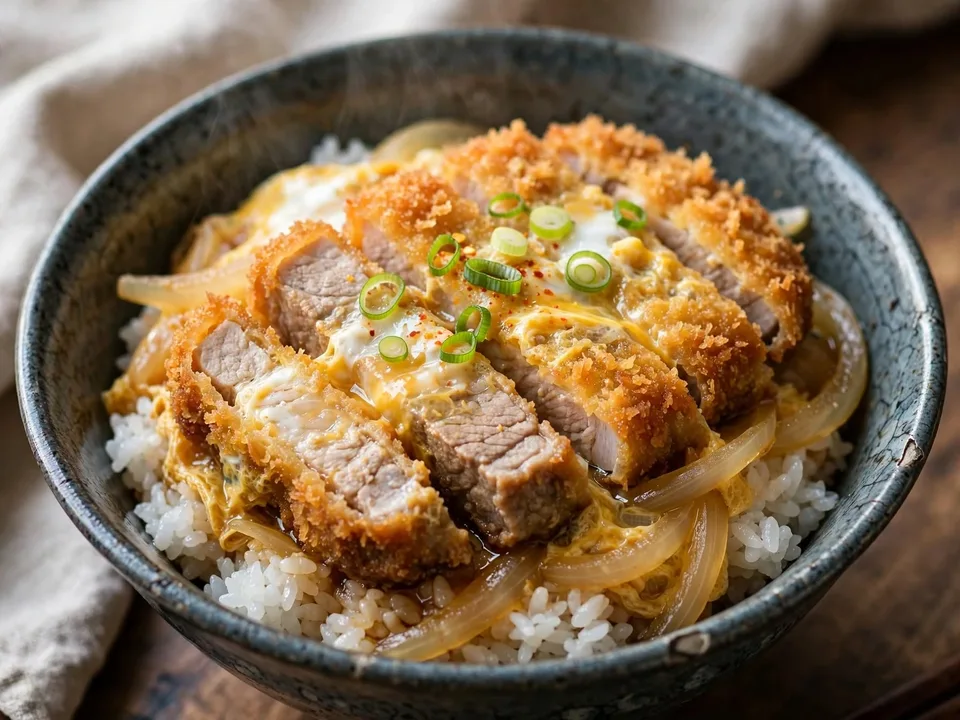
The finished bowl should show golden panko edges, glossy soft egg, translucent onion and fluffy rice, with no watery excess broth.
Kitchen note
The final chef test is one complete bite: fluffy rice, savory dashi sauce, tender onion, juicy pork, crisp panko and softly set egg should all be present together.
After cooking
Explore the dish beyond the method.
Story, place and references are here for discovery, so they stay out of the way while you cook.
Culture & tradition
The story behind the dish
Origins, evolution and everyday life—read together as part of the recipe's culinary record.
Origins
Pork cutlets entered Japanese cooking through yÅshoku, or Western-influenced dishes, before being adapted into rice-bowl forms suited to everyday eating.
How it evolved
Different regions built distinct katsudon identities: sauce styles, egg-bound versions and local seasonings all coexist.
Its place today
It remains a popular filling donburi, valued for the contrast between rice, savory sauce, egg and fried pork.
Visual archive · plate 01
Katsudon
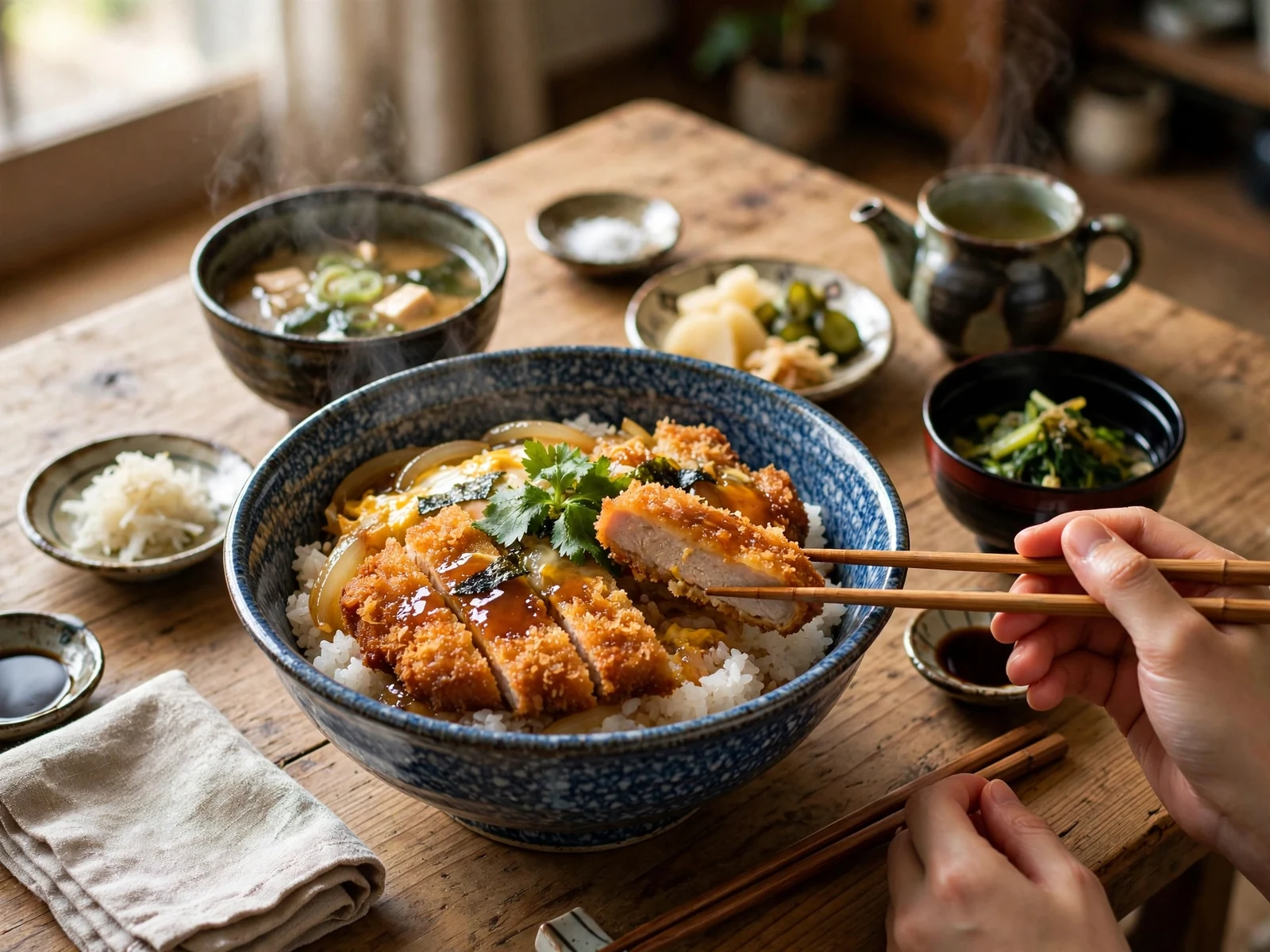
An editorial view of the finished dish, kept compact so the story continues without an oversized image break.
Primary region
Japan, with documented regional forms including Yamanashi
Country
Japan
Regional influence
Rice agriculture, pork cookery and the adaptation of breaded cutlets to Japanese donburi culture converge in katsudon.
Related food systems
- Donburi
- YÅshoku
- Japanese fried foods
Culinary record
- Sub-region
- East Asia — Pacific Archipelago
- Climate
- Temperate Maritime
- Trade-route influence
- Maritime Silk Road · Nanban trade (16th c. Portuguese)
Sources & further reading
Follow the reference trail.
Ember & Equator links outward when an institution or primary reference helps support the culinary record.
- 01Katsudon (Rice Topped with Pork Cutlet)External ↗
Ministry of Agriculture, Forestry and Fisheries of Japan (MAFF) · government
Supports: katsudon · Yamanashi regional variation · pork cutlet rice bowl
Ember & Equator source review · 2026-09-16
- 02Katsudon (Tonkatsu Rice Bowl)External ↗
Kikkoman Corporation · reference
Supports: egg-bound katsudon · dashi-soy-mirin broth · two-stage egg addition · rice bowl assembly
Ember & Equator source review · 2026-09-16
- 03Tonkatsu (Japanese Pork Cutlet)External ↗
Kikkoman Corporation · reference
Supports: tonkatsu preparation · panko breading rest · 170°C frying · wire-rack draining
Ember & Equator source review · 2026-09-16
- 04Katsudon (Pork Cutlet Rice Bowl)External ↗
Just One Cookbook · reference
Supports: onion simmered in dashi before seasoning · tonkatsu warming in seasoned broth · egg finishing and rice-bowl assembly
Ember & Equator source review · 2026-09-27
Ingredient guides
Learn about the ingredients behind the dish.
These are reference guides, not a second ingredient list. Follow an ingredient when you want to understand its role, use and wider culinary context.
Ingredient
pork loin cutlets
Understand what it contributes, how to use it, and the dishes that reveal it best.
Ingredient
fine salt
Understand what it contributes, how to use it, and the dishes that reveal it best.
Ingredient
black pepper
Understand what it contributes, how to use it, and the dishes that reveal it best.
Ingredient
plain flour
Understand what it contributes, how to use it, and the dishes that reveal it best.
Ingredient
egg
Understand what it contributes, how to use it, and the dishes that reveal it best.
Ingredient
panko breadcrumbs
Understand what it contributes, how to use it, and the dishes that reveal it best.
Keep wandering
Where will this dish take you next?
Stay with the place, follow an ingredient or technique, or cross into another food culture. Each path begins with something already present in this dish.
Stay with the place
01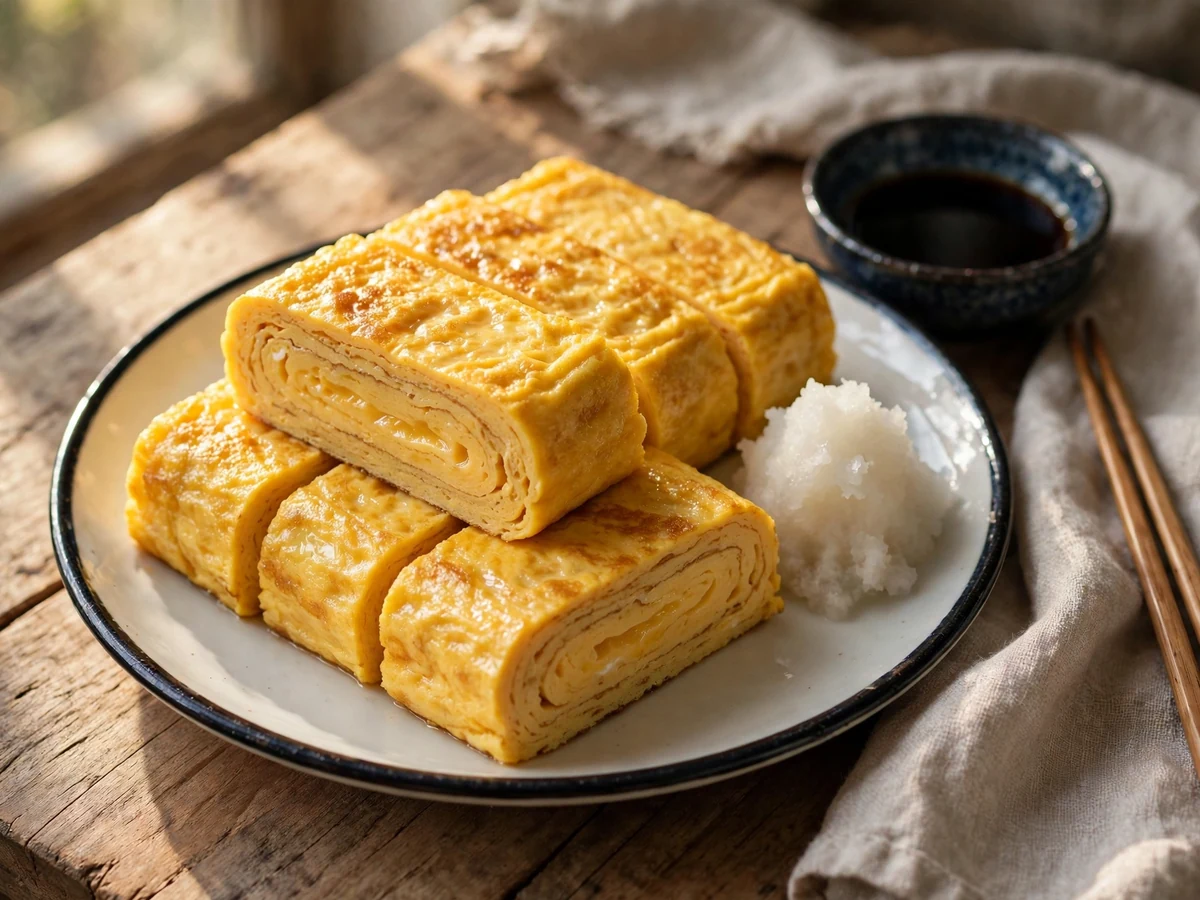
Japan
Tamagoyaki
Stay in the same food culture and follow fine salt into another recipe.
Shared thread · fine salt · egg · neutral oil
Follow the method or pantry
02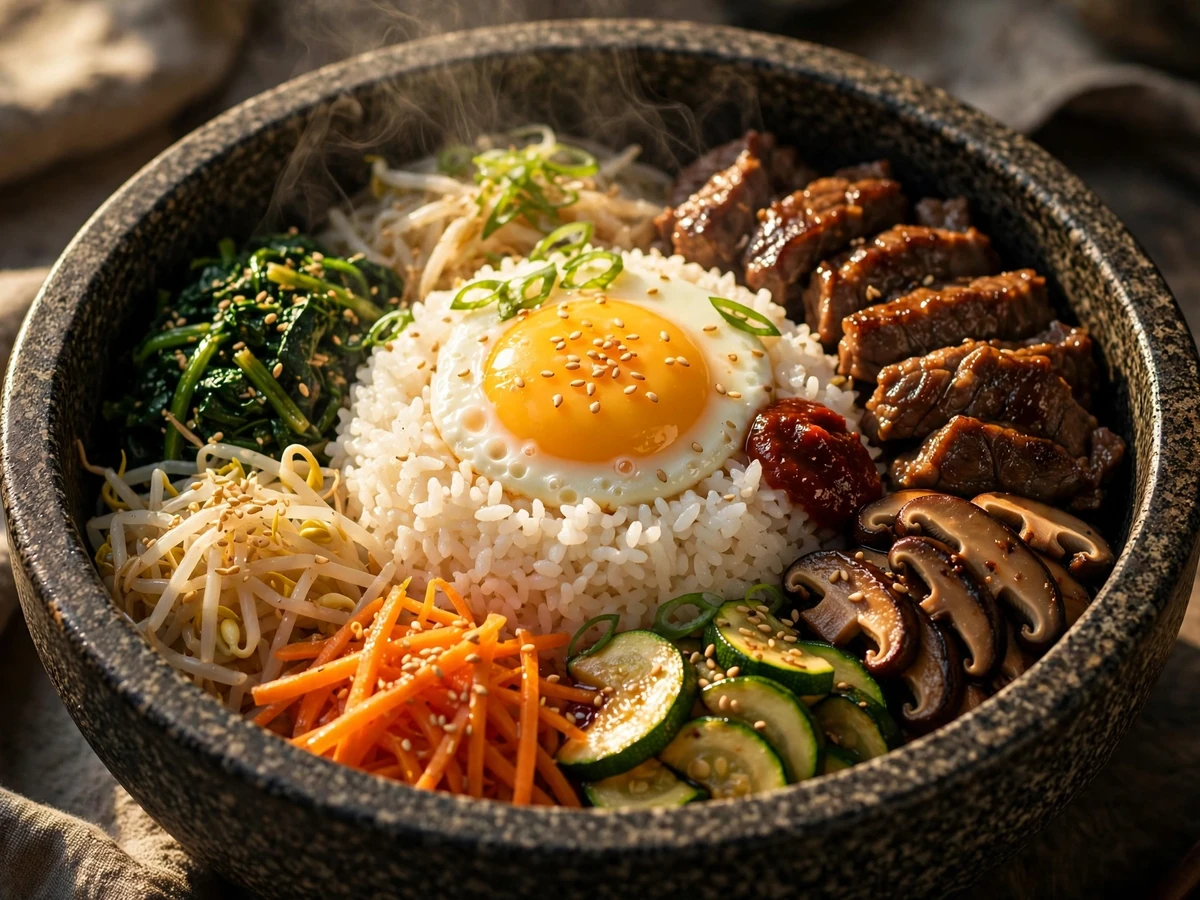
South Korea
Bibimbap
Follow the cooking method: both dishes connect through fry.
Shared thread · Fry · black pepper · egg
Cross a culinary border
03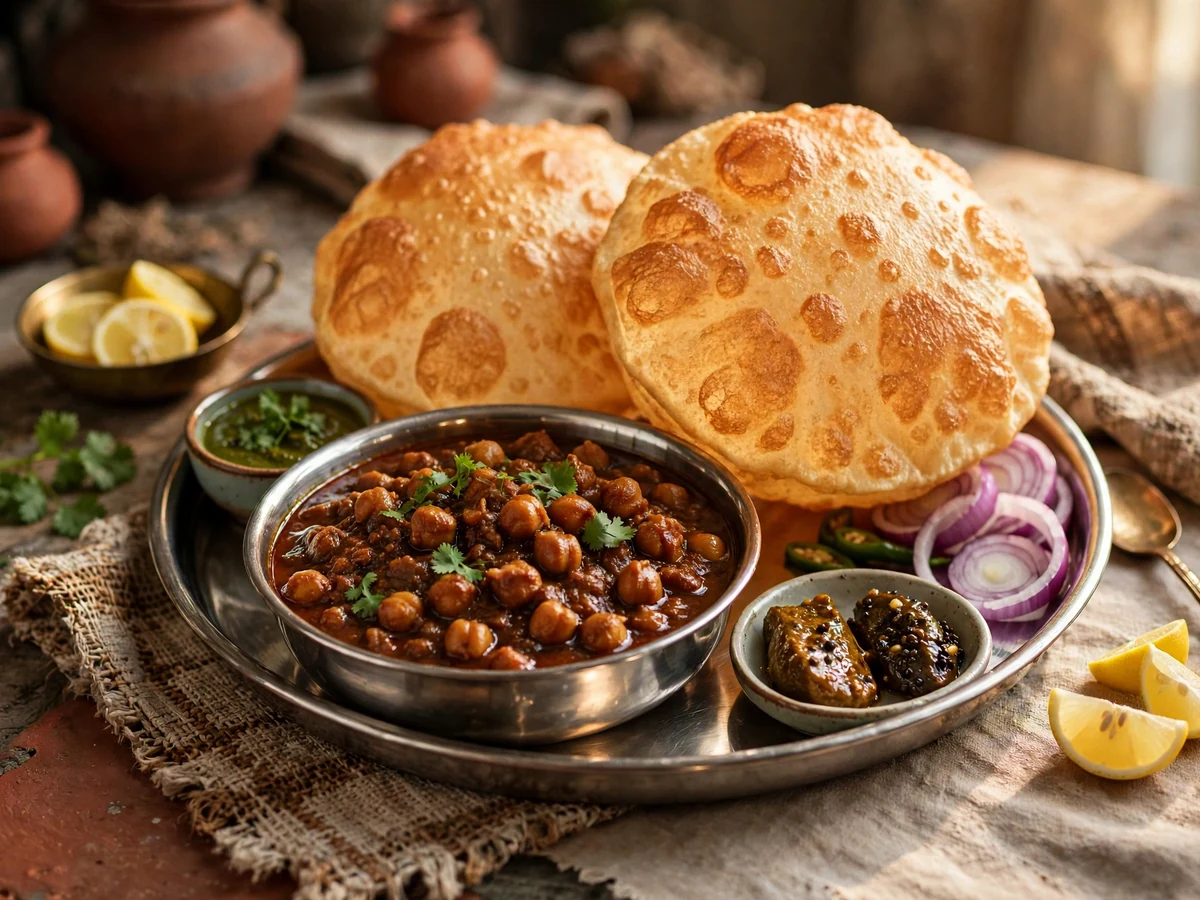
India
Chole Bhature
Cross borders while keeping fry as the common thread.
Shared thread · Fry · Simmer · plain flour
Go one layer deeper
One small detail can open an entirely different part of food.
Continue in Ember & Equator