
Japan · breakfast · lunch · snack
Tamagoyaki
Japan through one enduring dish.
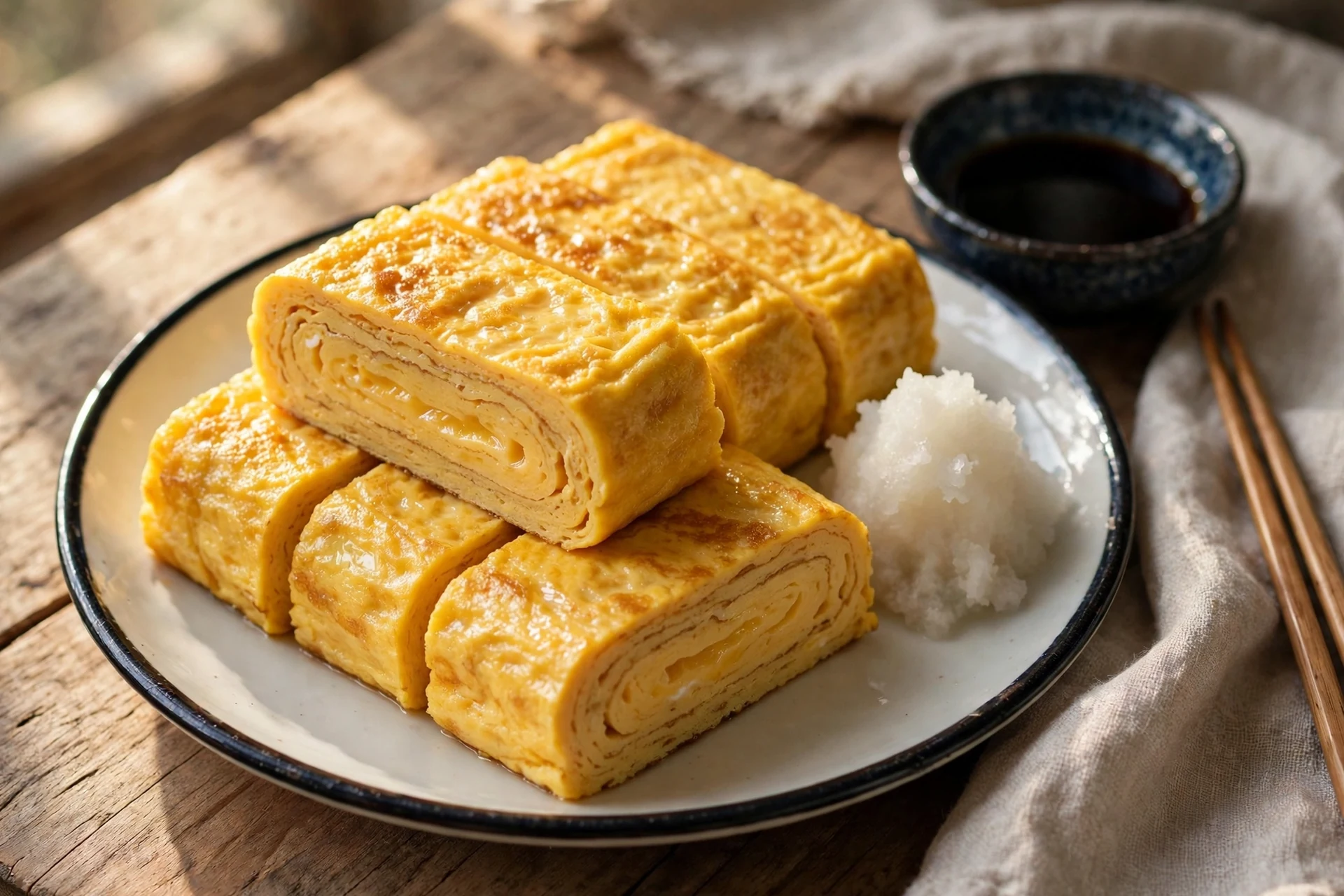
Tamagoyaki is a Japanese rolled omelet cooked in successive thin layers. This Tokyo/Kanto-leaning version balances dashi, sugar, soy sauce and salt, with the cook controlling pan heat so each layer sets enough to roll while remaining moist enough to bond to the next.
- Total
- 20 min
- Difficulty
- Medium
- Serves
- 2
- Steps
- 10
The dish
Place first. Then the plate.
Japan’s Ministry of Agriculture, Forestry and Fisheries documents Tokyo/Kanto tamagoyaki as a sweet atsuyaki tamago that may take on light browning, while Kansai dashimaki tamago is more dashi-forward and is cooked with little or no browning. Household seasoning still varies widely, so Ember & Equator presents one Kanto-leaning sweet-savory method while teaching the transferable layering, heat-control and shaping technique rather than treating one formula as the only authentic version.
Explore JapanAt a glance
Origin
Japan
Region
Tokyo/Kanto-leaning method; tamagoyaki is eaten nationwide in Japan
Meal
breakfast · lunch · snack
Guided steps
10
Dish
Tamagoyaki
Cuisine
Japanese cuisine
Food type
Breakfast · Lunch · Snack
Technique
Roll omelet
Cook the recipe
In the kitchen
Start with the ingredients, then follow the Method in order. Open cooking tips only when you need extra help; the story and references can wait until you are ready.
- Total
- 20 min
- Serves
- 2
- Level
- Medium
- Visual cues
- 10
Ingredients
Serves 2- 4 largeeggsroom temperature is helpful but not essential
- 2 tbspdashi stockcool or room temperature; avoid adding hot dashi directly to raw eggs
- 1 tbspsugarfor a gently sweet Kanto-style balance
- 1 tspsoy saucelight seasoning; too much can darken and toughen the layers
- 1/8 tspfine salta small pinch is enough because soy sauce also contributes salt
- 2 tspneutral oilfor repeatedly wiping a very thin film over the pan
Everything ready? Continue straight into the cooking steps.
Start methodMethod
10 steps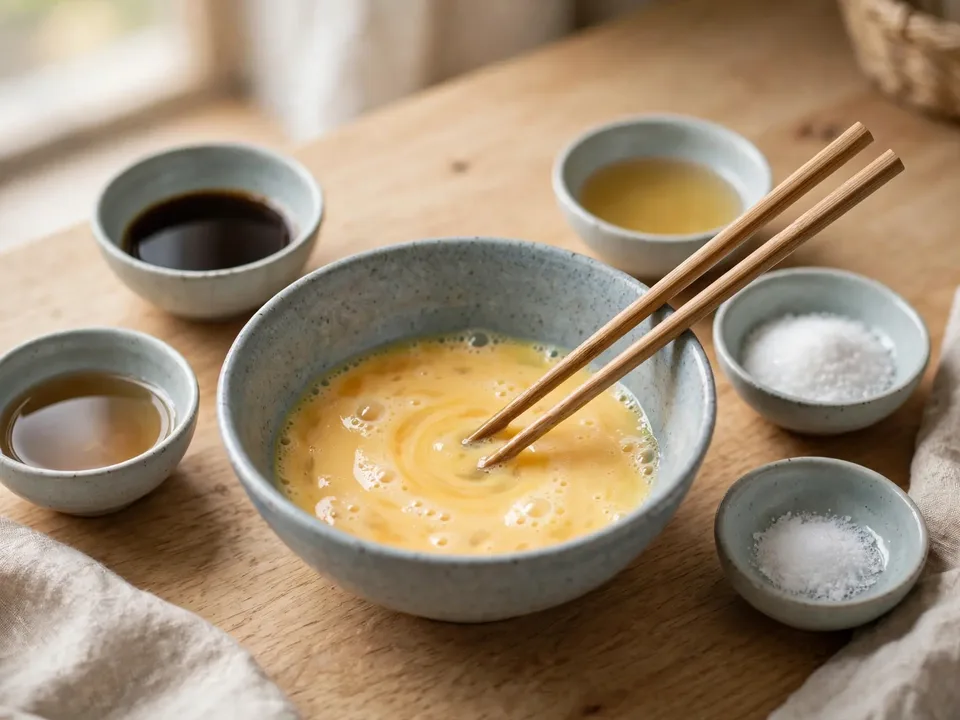 Step 01
Mix the eggs gently
2 min
Crack the eggs into a bowl and beat them gently with chopsticks using short slicing motions rather than vigorous whisking.
Crack the eggs into a bowl and beat them gently with chopsticks using short slicing motions rather than vigorous whisking. Break up the whites until the mixture is mostly smooth, but avoid creating lots of bubbles because a foamy mixture makes the finished omelet fragile and pitted.
Look for
The egg mixture should be evenly yellow, pourable and mostly free of foam, with no obvious streaks of unmixed white.
Kitchen note
Gentle mixing is one of the foundations of refined tamagoyaki. The goal is a fluid mixture with very little foam, not a fluffy scrambled-egg base.
 Step 02
Season precisely
1 min
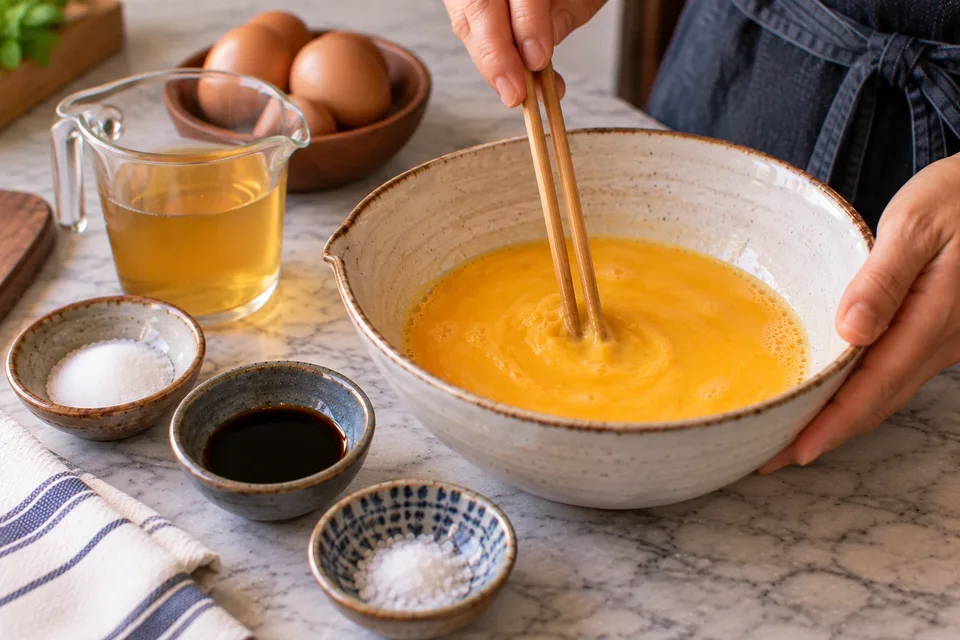
Add the dashi, sugar, soy sauce and a small pinch of salt to the eggs.
Add the dashi, sugar, soy sauce and a small pinch of salt to the eggs. Stir gently until the sugar and salt dissolve fully so the seasoning is evenly distributed through every layer.
Look for
The mixture should still look fluid and smooth after seasoning, without sugar crystals pooling at the bottom.
Kitchen note
Dashi should support the egg rather than dominate it. A small amount adds savoriness and delicacy, but too much liquid makes rolling much harder.
 Step 03
Strain for a smoother finish
1 min
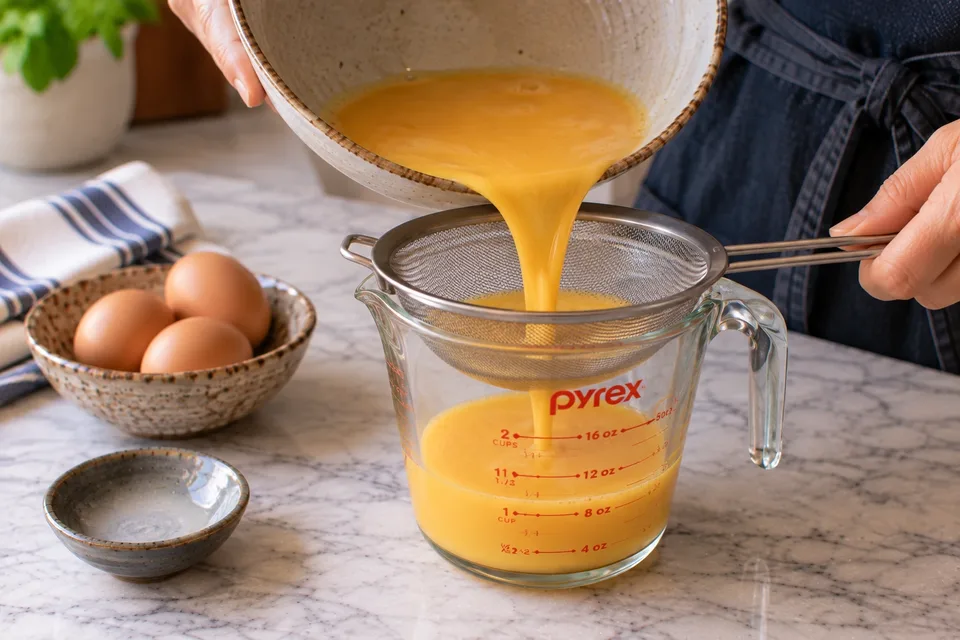
For a refined, especially smooth finish, pour the seasoned egg mixture through a fine-mesh sieve into a clean bowl.
For a refined, especially smooth finish, pour the seasoned egg mixture through a fine-mesh sieve into a clean bowl. This removes ropey pieces of egg white and makes the finished layers more even; for everyday home cooking, this polishing step can be skipped if the eggs were mixed very thoroughly.
Look for
The strained mixture should look glossy, uniform and free of ropey strands of egg white.
Kitchen note
Straining is a refinement rather than an authenticity test. It is useful when you want a particularly smooth, tidy cross-section.
 Step 04
Preheat the pan
2 min
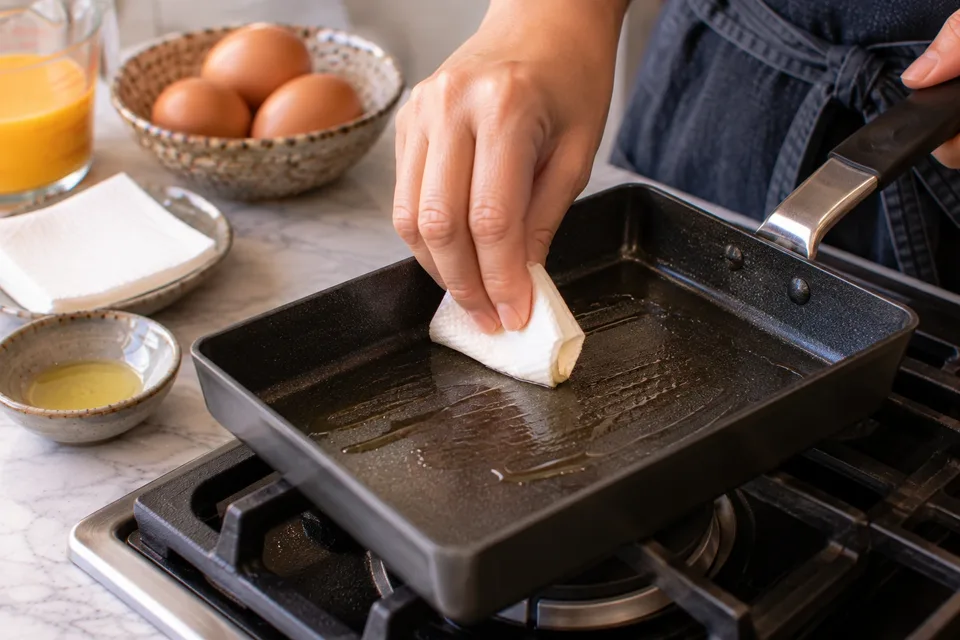
Heat a rectangular tamagoyaki pan over medium-low heat.
Heat a rectangular tamagoyaki pan over medium-low heat. Lightly oil the entire surface, including the corners, with a folded paper towel dipped in neutral oil. The pan should be hot enough for the egg to begin setting immediately, but not so hot that it sizzles aggressively or browns at once.
Look for
A drop of egg should set with a quiet sizzle and remain mostly yellow rather than turning brown right away.
Kitchen note
Tamagoyaki is cooked by visual cues more than by the clock. If the egg browns before you can roll it, the heat is too high.
 Step 05
Pour the first layer
1 min
Pour in a thin layer of egg and tilt the pan so it spreads evenly from edge to edge.
Pour in a thin layer of egg and tilt the pan so it spreads evenly from edge to edge. Pop any large bubbles with chopsticks. Keep the layer thin: delicate sheets create the fine spiral that good tamagoyaki shows when sliced.
Look for
The layer should cover the base in a thin sheet, setting underneath while the top still looks slightly moist.
Kitchen note
Err on the side of less egg per layer. Thin layers are easier to control and build a prettier, more even omelet. Use only enough egg to make a thin film across the pan; if a thick puddle remains, tilt the pan to spread it before the edges set.
 Step 06
Roll while still moist
1 min
When the underside is set but the surface remains slightly wet and glossy, roll the egg from one end of the pan to the other.
When the underside is set but the surface remains slightly wet and glossy, roll the egg from one end of the pan to the other. Use chopsticks or a spatula to keep the roll tight without tearing it.
Look for
The sheet should release cleanly from the pan yet still show slight gloss on top when you begin rolling.
Kitchen note
Do not wait until the layer is completely dry. A little surface moisture helps the next layer fuse cleanly to the roll. If the first layer tears, do not discard it: push the pieces together, roll them into the centre and let the next thin layer bind the shape.
 Step 07
Build the layers
3 min
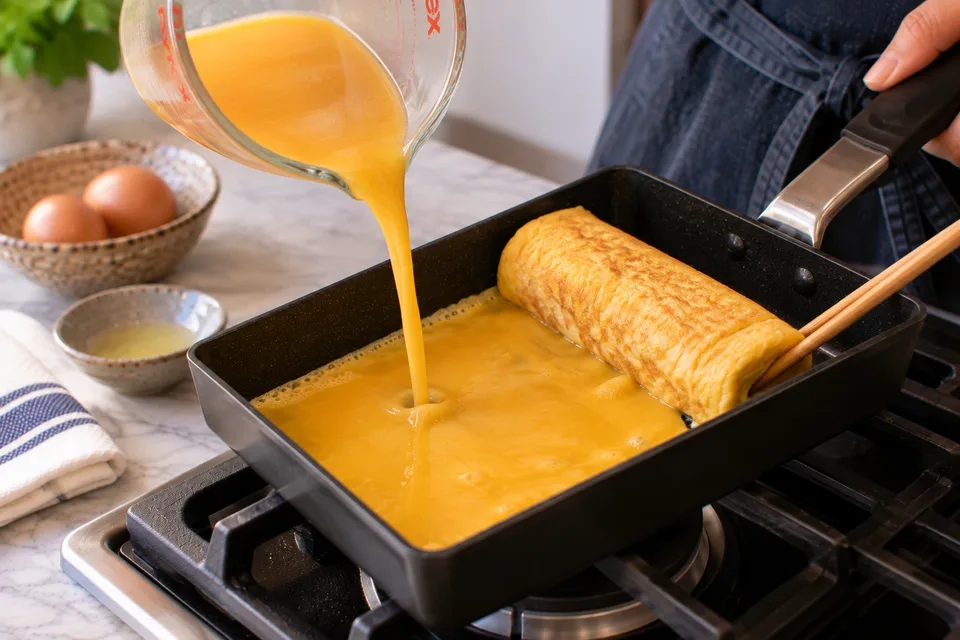
Push the roll back to one side of the pan and lightly re-oil the exposed surface.
Push the roll back to one side of the pan and lightly re-oil the exposed surface. Pour in another thin layer of egg, then lift the existing roll slightly so the fresh egg can run underneath it. Once the new layer is nearly set, roll the existing omelet back over it.
Look for
The new egg should spread underneath the roll, and the sheet should be soft enough to bond before it fully dries.
Kitchen note
Letting the fresh egg run under the roll is the key to a compact layered spiral rather than separate sheets with gaps between them.
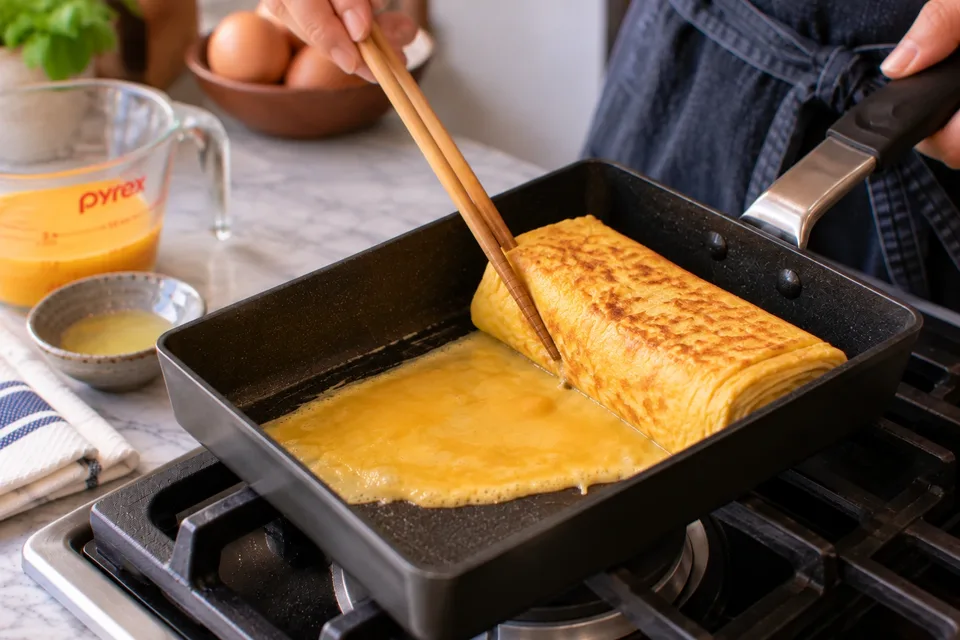 Step 08
Repeat until all the egg is used
2 min
Continue the same process of re-oiling lightly, pouring thin layers, letting the egg flow under the roll and rolling again until all the mixture has been used.
Continue the same process of re-oiling lightly, pouring thin layers, letting the egg flow under the roll and rolling again until all the mixture has been used. Keep the heat steady throughout. In this Kanto-leaning sweet style, light golden browning is acceptable, but avoid dark patches or scorching.
Look for
The finished roll should look compact and layered, golden-yellow with light controlled browning but no dark or scorched patches.
Kitchen note
Sugar encourages colour quickly. Gentle, steady heat gives you a tender interior with controlled golden browning instead of a dark, tough exterior. Between layers, wipe on a very thin film of oil and briefly lower or lift the pan from the heat if the egg begins browning before you can roll it.
 Step 09
Shape the omelet
1 min
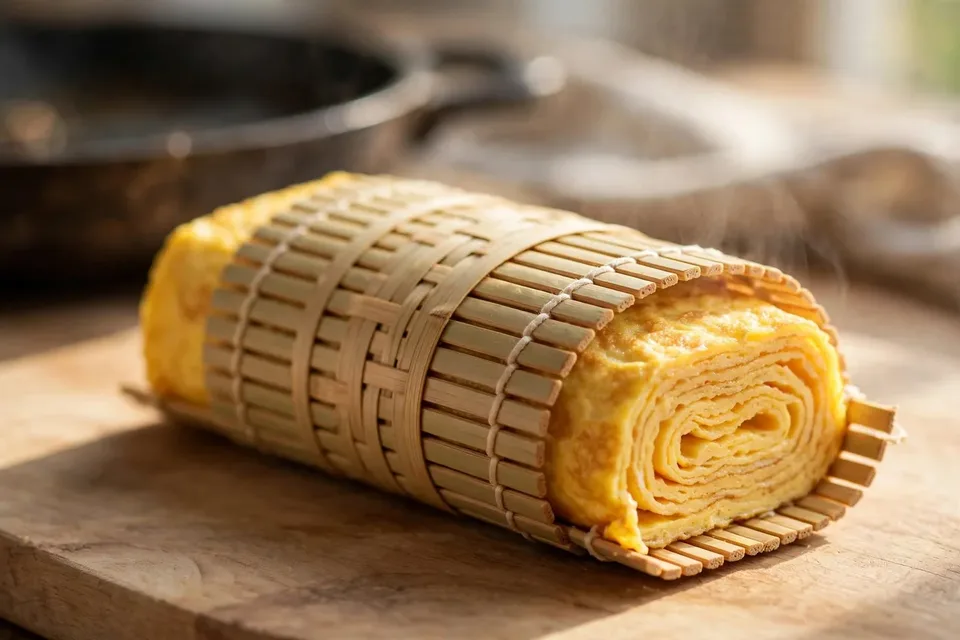
While the tamagoyaki is still hot, gently press and square it using the corners of the pan, a spatula or a bamboo mat.
While the tamagoyaki is still hot, gently press and square it using the corners of the pan, a spatula or a bamboo mat. This firms the edges and gives the omelet its clean rectangular profile without crushing the tender layers.
Look for
The roll should hold a neat rectangular form with visible layers and no liquid egg leaking out.
Kitchen note
Do not chase perfect edges during rolling. The pan and a gentle final shaping step act as your mold.
 Step 10
Rest and slice
3 min
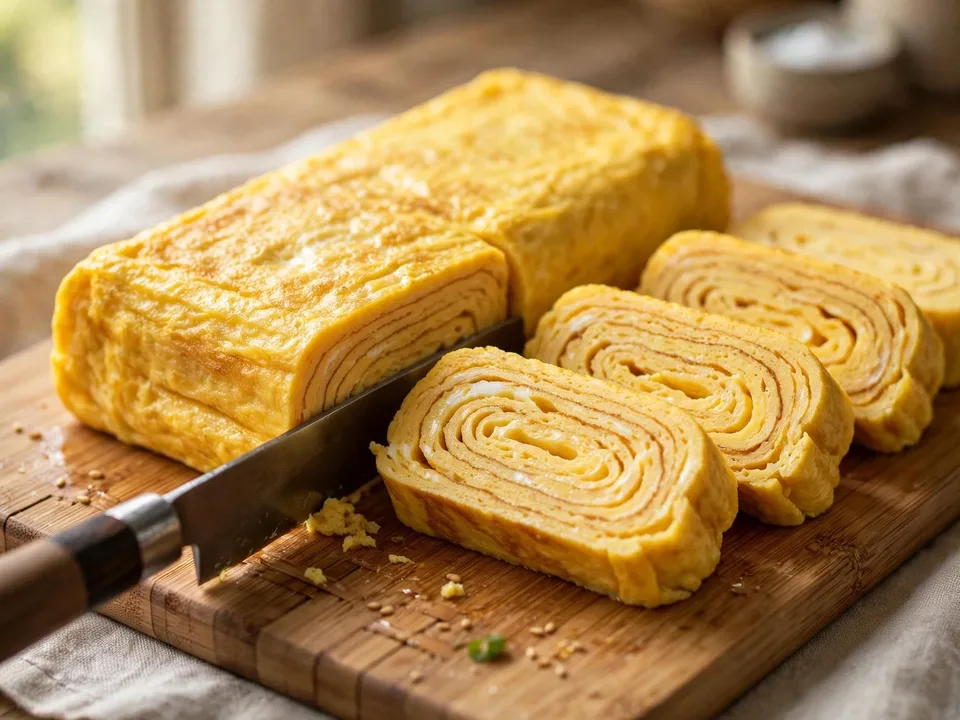
Transfer the tamagoyaki to a board and rest it for 2–3 minutes so the layers can settle.
Transfer the tamagoyaki to a board and rest it for 2–3 minutes so the layers can settle. Slice with a sharp, slightly damp knife into even pieces and serve warm or at room temperature. For bento, make sure the omelet is cooked through and cool it completely before closing the container so trapped steam does not wet the surface.
Look for
The cut face should show fine, compact layers and a moist tender interior, with controlled light golden browning rather than dark scorched patches.
Kitchen note
Rest briefly before slicing so the layered roll sets cleanly. For this Kanto-leaning sweet-savory version, controlled light golden browning is acceptable; dark scorching is not.
After cooking
Explore the dish beyond the method.
Story, place and references are here for discovery, so they stay out of the way while you cook.
Culture & tradition
The story behind the dish
Origins, evolution and everyday life—read together as part of the recipe's culinary record.
Origins
MAFF traces the wider lineage of tamagoyaki in Tokyo to Edo-period egg cookery, when eggs became more widely eaten after earlier restrictions and preparations such as tamago fuwafuwa entered popular cooking. Modern tamagoyaki is therefore better understood as a long-evolving family of rolled/thick omelets than as one fixed formula.
How it evolved
Rectangular tamagoyaki pans made repeated thin-layer rolling easier to reproduce, while sushi, bento and everyday home cooking helped keep the technique familiar across Japan. Kanto and Kansai traditions developed different balances of sweetness, dashi and browning.
Its place today
Tamagoyaki is commonly eaten at breakfast, packed in bento, served as a side dish and used in sushi contexts, ranging from sweet Kanto-style versions to softer dashi-rich preparations.
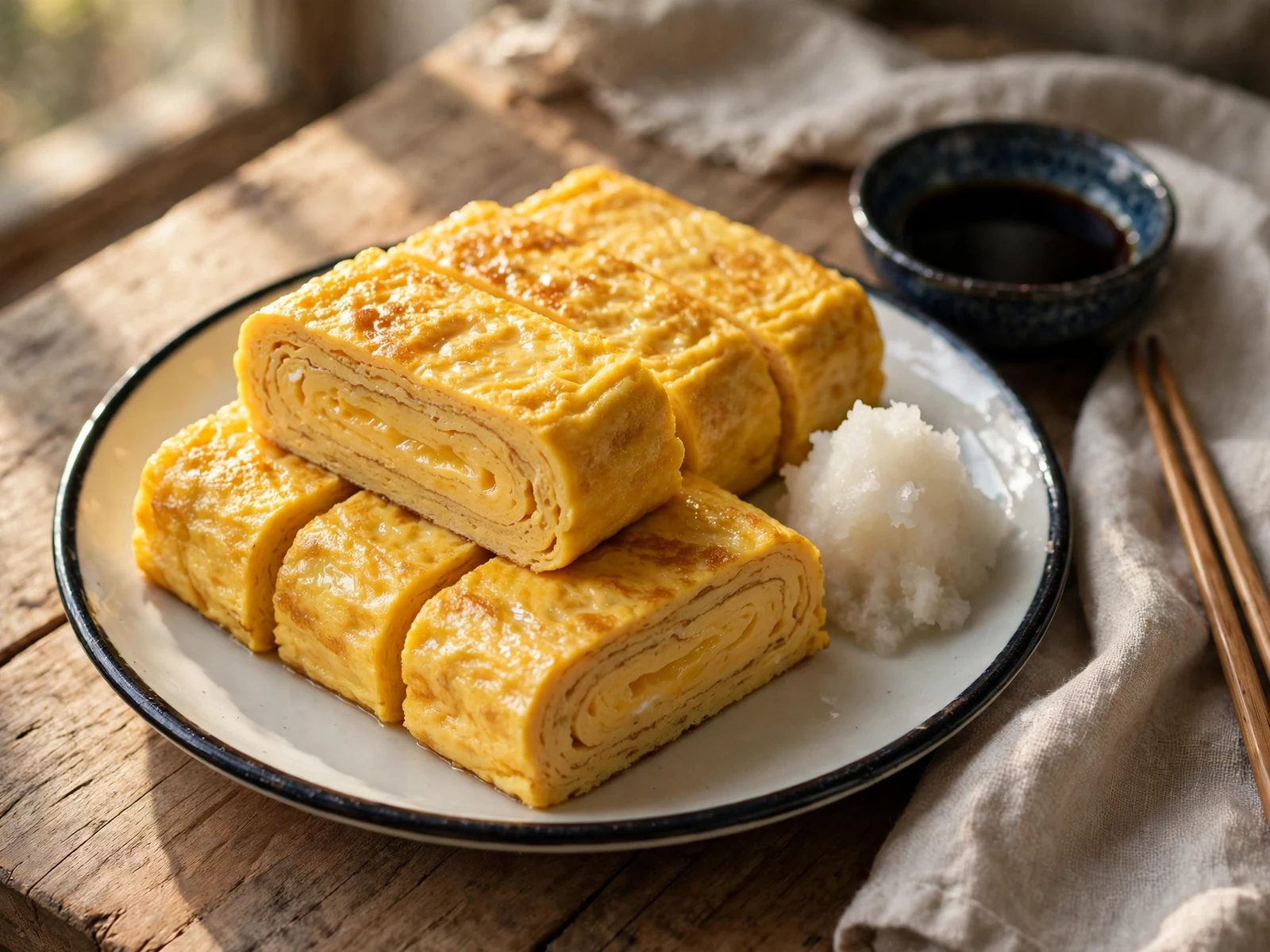
Visual archive · plate 01
Tamagoyaki
An editorial view of the finished dish, kept compact so the story continues without an oversized image break.
Primary region
Tokyo/Kanto-leaning method; tamagoyaki is eaten nationwide in Japan
Country
Japan
Regional influence
The dish belongs to Japanese home-cooking and bento traditions rather than being defined by one climate. Dashi, soy sauce and controlled egg cookery connect it to wider Japanese seasoning practices.
Related food systems
- Japanese home cooking
- Bento culture
- Dashi-based seasoning
- Japanese egg cookery
Culinary record
- Sub-region
- East Asia — Pacific Archipelago
- Climate
- Temperate Maritime
- Trade-route influence
- Maritime Silk Road · Nanban trade (16th c. Portuguese)
Sources & further reading
Follow the reference trail.
Ember & Equator links outward when an institution or primary reference helps support the culinary record.
- 01TamagoyakiExternal ↗
Ministry of Agriculture, Forestry and Fisheries of Japan (MAFF) · government
Supports: Kanto and Kansai regional distinction · eggs, stock and sugar seasoning · thin-layer rolling and sushi-mat shaping
Ember & Equator source review · 2026-09-16
- 02Tamagoyaki Recipe (Japanese Sweet Rolled Omelette)External ↗
Kikkoman Corporation · reference
Supports: gentle egg mixing · pan temperature test · rolling while the surface is still moist · re-oiling and running fresh egg under the roll · shaping in a sushi mat
Ember & Equator source review · 2026-09-16
Ingredient guides
Learn about the ingredients behind the dish.
These are reference guides, not a second ingredient list. Follow an ingredient when you want to understand its role, use and wider culinary context.
Ingredient
egg
Understand what it contributes, how to use it, and the dishes that reveal it best.
Ingredient
dashi stock
Understand what it contributes, how to use it, and the dishes that reveal it best.
Explore ingredient →
Ingredient
sugar
Understand what it contributes, how to use it, and the dishes that reveal it best.
Ingredient
soy sauce
Understand what it contributes, how to use it, and the dishes that reveal it best.
Explore ingredient →
Ingredient
fine salt
Understand what it contributes, how to use it, and the dishes that reveal it best.
Ingredient
neutral oil
Understand what it contributes, how to use it, and the dishes that reveal it best.
Keep wandering
Where will this dish take you next?
Stay with the place, follow an ingredient or technique, or cross into another food culture. Each path begins with something already present in this dish.
Stay with the place
01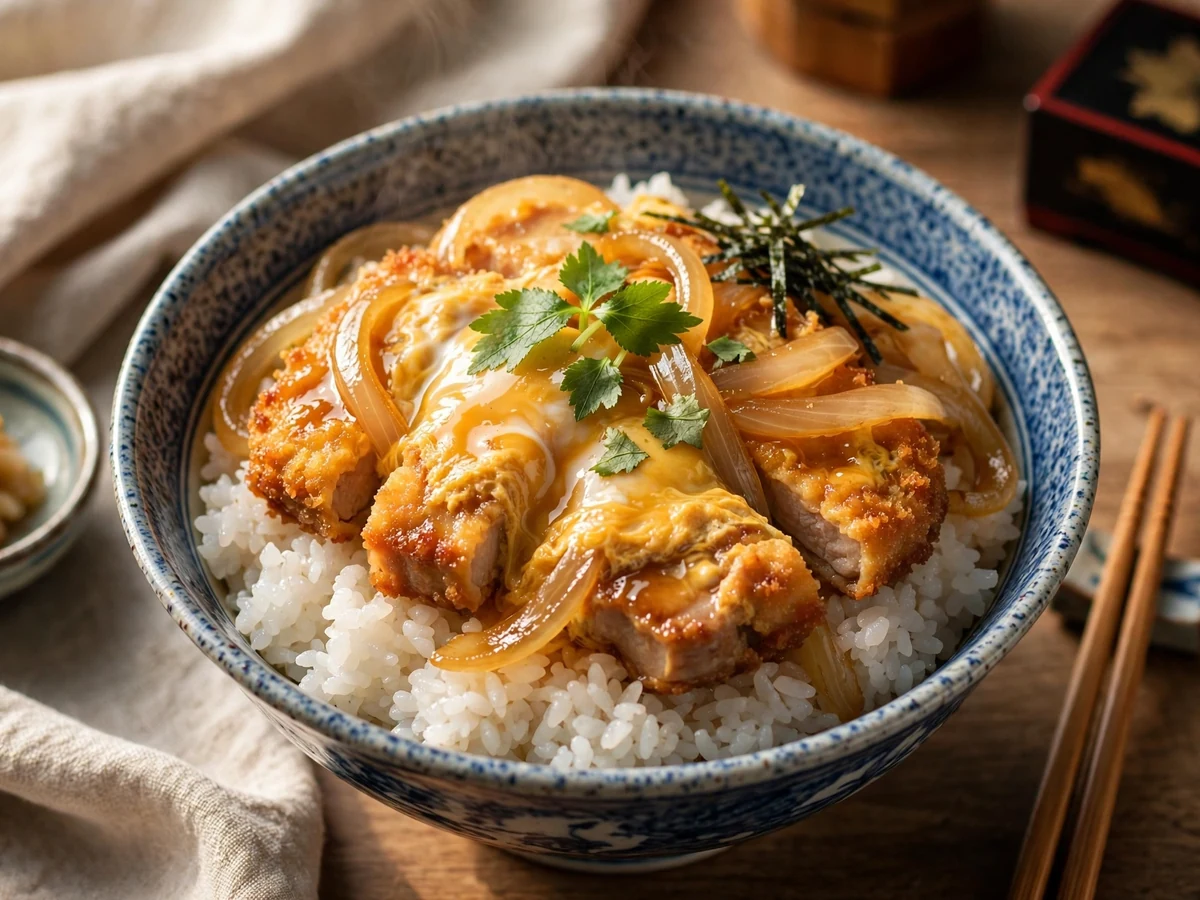
Japan
Katsudon
Stay in the same food culture and follow egg into another recipe.
Shared thread · egg · dashi stock · sugar
Follow the method or pantry
02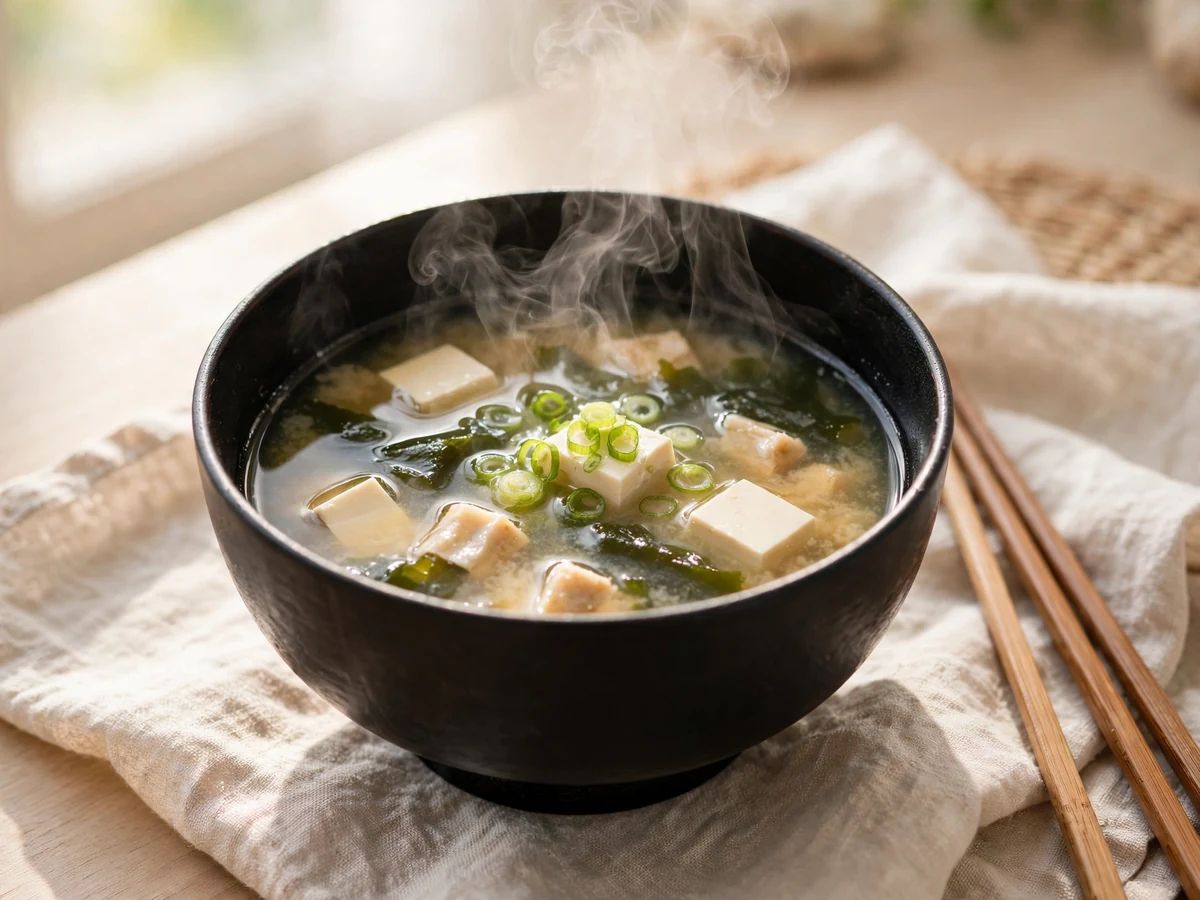
Japan
Miso Soup
Follow the pantry: both dishes connect through dashi stock.
Shared thread · dashi stock · Breakfast · Lunch
Cross a culinary border
03
India
Indori Poha
Cross borders and see how another cuisine handles sugar.
Shared thread · sugar · fine salt · neutral oil
Go one layer deeper
One small detail can open an entirely different part of food.
Continue in Ember & Equator